Friday, July 6, 2018

Skeptical about Cryptocurrencies

Cryptocurrencies like Bitcoin have many interesting properties as financial assets, but are they ever likely to become money? The Bank for International Settlements (BIS) devotes Chapter V of its Annual Report 2017-18 (released June 24, 2018) to the topic "Cryptocurrencies: looking beyond the hype."  Here's the main thrust of the argument:
"[T]he essence of good money has always been trust in the stability of its value. And for money to live up to its signature property – to act as a coordination device facilitating transactions – it needs to efficiently scale with the economy and be provided elastically to address fluctuating demand. ... The chapter then gives an introduction to cryptocurrencies and discusses the economic limitations inherent in the decentralised creation of trust which they entail. For the trust to be maintained, honest network participants need to control the vast majority of computing power, each and every user needs to verify the history of transactions and the supply of the cryptocurrency needs to be predetermined by its protocol. Trust can evaporate at any time because of the fragility of the decentralised consensus through which transactions are recorded. Not only does this call into question the finality of individual payments, it also means that a cryptocurrency can simply stop functioning, resulting in a complete loss of value. Moreover, even if trust can be maintained, cryptocurrency technology comes with poor efficiency and vast energy use. Cryptocurrencies cannot scale with transaction demand, are prone to congestion and greatly fluctuate in value. Overall, the decentralised technology of cryptocurrencies, however sophisticated, is a poor substitute for the solid institutional backing of  money. That said, the underlying technology could have promise in other applications, such as the simplification of administrative processes in the settlement of financial transactions. Still, this remains to be tested."
Here are some figures that caught my eye on the energy consumption and scaling issues that face cryptocurrencies


On the issue of energy use, as the "miners" who update the system while solving computational problems burn energy to do so: "Individual facilities operated by miners can host computing power equivalent to that of millions of personal computers. At the time of writing, the total electricity use of bitcoin mining equalled that of mid-sized economies such as Switzerland, and other cryptocurrencies also use ample electricity. Put in the simplest terms, the quest for decentralised trust has quickly become an environmental disaster."

Verifying a cryptocurrency transaction through the blockchain is not only costly in terms of electricity, it's slow. This slowness isn't a bug; it's a feature--that is, it's built in to how the blockchain verifies transactions.  "[A]t the time of writing, the Bitcoin blockchain was growing at around 50 GB per year and stood at roughly 170 GB. Thus, to keep the ledger’s size and the time needed to verify all transactions (which increases with block size) manageable, cryptocurrencies have hard limits on the throughput of transactions."


The underlying architecture of crytocurrencies is that they are updated in blocks, which can only be added an prespecified intervals of time after earlier blocks have been completed. When demand for transactions gets high, the system becomes congested and transactions sometime wait several hours before being verified. "Another aspect of the scalability issue is that updating the ledger is subject to congestion. For example, in blockchain-based cryptocurrencies, in order to limit the number of transactions added to the ledger at any given point in time, new blocks can only be added at pre-specified intervals. Once the number of incoming transactions is such that newly added blocks are already at the maximum size permitted by the protocol, the system congests and many transactions go into a queue. With capacity capped, fees soar whenever transaction demand reaches the
capacity limit . And transactions have at times remained in a queue for several hours, interrupting the payment process. This limits cryptocurrencies’ usefulness for day-to-day transactions such as paying for a coffee or a conference fee, not to mention for wholesale payments. Thus, the more people use a cryptocurrency, the more cumbersome payments become."

Here's a figures showing spikes in daily average transaction fees for several cryptocurrencies:
Put these issues of high and volatile transactions costs together with the extreme volatility in the price of cryptocurrencies, even those that are supposedly designed to have relatively stable values, and their widespread use as  "money" seems implausible.

But the underlying blockchain technology might prove itself useful in other ways, "in niche settings where the benefits of decentralised access exceed the higher operating cost of maintaining multiple copies of the ledger." These uses often will not involve cryptocurrencies, but will instead be "cryptopayment" systems where the blockchain technology is used by a group of players who have permission to be on the system to handle long-distance payments. For example, the World Food Programme’s ran a blockchain-based cryptopayment system to send funds for food aid serving Syrian refugees in Jordan. More broadly, a blockchain based system might cut transaction costs for the global remittance flows of $540 billion annually. Or a "smart contract" system might be set up to facilitate trade financing, such that exporters can be reassured that they will be paid and importers can be reassured that what they paid for has actually shipped.

My own sense is that blockchain is likely to be one more entry in the list of technologies that were invented for one purpose--in this case, cryptocurrency--but ended up instead being most useful for other purposes, from targeted finance to safe-recordkeeping to keeping track of supply chains. For more on Bitcoin and blockchain, see:


Thursday, July 5, 2018

Was the American Revolution Good for Liberty?

Of course, the American Revolutionary War detached the United States from England, but from a broader standpoint of human liberty the simple fact of this political separation was not a major event. Were there actually more substantial human gains for human liberty? Jeffrey Rogers Hummel discusses some outcomes in "Benefits of the American Revolution: An Exploration of Positive Externalities," published at the Library of Economics and Liberty website (July 2, 2018). Hummel suggests four main benefits to liberty for those living in the new country:
1. The First Abolition: Prior to the American Revolution, every New World colony, British or otherwise, legally sanctioned slavery, and nearly every colony counted enslaved people among its population. As late as 1770, nearly twice as many Africans were in bondage throughout the colony of New York as within Georgia, although slaves were a much larger percentage of Georgia’s population. Yet the Revolution’s liberating spirit brought about outright abolition or gradual emancipation in all northern states by 1804. ...  In 1786, the Confederation Congress also prohibited the extension of slavery into the Northwest Territory.
There is a tendency to minimize this first emancipation because slavery had been less economically entrenched in the northern colonies than in the southern colonies and because in many northern states slavery was eliminated gradually. But emancipation had to start somewhere. ... Even in southern colonies, the Revolution’s assault on human bondage made some inroads. Several southern states banned the importation of slaves and relaxed their nearly universal restrictions on masters voluntarily freeing their own slaves. Through resulting manumissions, 10,000 Virginia slaves were freed, more than were freed in Massachusetts by judicial decree. ...
2. Separation of Church and State: ... Although the British colonies prior to the Revolution already practiced a relatively high degree of religious toleration, only four of thirteen colonies had no established, tax-supported church: Rhode Island, New Jersey, Pennsylvania, and Delaware. As a result of the Revolution, the five other southern states and New York disestablished the Anglican Church. With the adoption of the Constitution and then the First Amendment, the United States become the first country to separate church and state at the national level. Several of the New England states, however, retained their established Congregational Church, with Massachusetts becoming the last to fully abolish tax support as late as 1833. In our modern secular age, it is too easy to take these accomplishments for granted, but they were unprecedented.
3. Republican Governments: As a result of the Revolution, nearly all of the former colonies adopted written state constitutions setting up republican governments with limitations on state power embodied in bills of rights. ...  The new state constitutions often extended the franchise, with Vermont being again the first jurisdiction to adopt universal male suffrage with no property qualifications and explicitly without regard to color. Going along with this was a reform of penal codes throughout the former colonies, making them less severe, and eliminating such brutal physical punishments as ear-cropping and branding, all still widely practiced in Britain. ...
4. Extinguishing the Remnants of Feudalism and Aristocracy: ... All the new states abolished primogeniture (the sole right of inheritance to the firstborn son) and entail (a prohibition of the sale, break up, or transfer to outside the family of an estate) where they existed, either by statute or by constitutional provisions. Doing so not only eliminated economically inefficient feudal encumbrances on land titles but also was a blow against hereditary privilege and the patriarchal family, because it undermined traditional patterns of inheritance and facilitated the rights of daughters and widows to possess property. ...
The U.S. Constitution’s prohibition on titles of nobility may seem trivial and quaint to modern eyes. But such titles, still prevalent throughout the Old World, always involved enormous legal privileges. This provision is, therefore, a manifestation of the extent to which the Revolution witnessed a decline in deference throughout society. ... White employees no longer referred to their employers as “master” or “mistress” but adopted the less servile Dutch word “boss.” Men generally began using the designation of “Mr.,” traditionally confined to the gentry. ... In the Revolution’s aftermath, indentured servitude for immigrants withered away, and most states eliminated legal sanctions enforcing long-term labor contracts for residents, thus giving birth to the modern system of free labor, where most workers (outside of the military) can quit at will. 
There's much more of interest in the essay, including discussion of how, in the years before the US Revolution, "British hard-liners intended to fasten on North America an imperial regime in many respects similar if not identical to British rule in India."

Another interesting speculation is that if Britain had held on to the American colonies, then Britain might not have been able to muster a political majority to abolish slavery in 1833. Britain's move to abolish slavery at that time was able to overcome the opposition from British sugar planters in the West Indies. Hummel speculates: "If American cotton, tobacco, rice, and sugar planters had still been under British rule, they inevitably would have allied with West Indian sugar planters, creating a far more powerful pro-slavery lobby. ... Thus it is likely that, without U.S. independence, slavery would have persisted in both North America and the West Indies after 1834 and, indeed, possibly after 1865." 

Wednesday, July 4, 2018

Melting Pot, Salad Bowl, Chocolate Fondue

Here's my attempt to resolve all the issues of shared American identity in under 1,000 words. It was published back in 2013 as an opinion piece in the (Minnesota) Star Tribune newspaper.


"Analogies for America: Beyond the Melting Pot"
Timothy Taylor


Melting pot or salad bowl? For decades now, these two contestants have been slugging it out in the contest for most appropriate metaphor for how the cultures and ethnicities of America fit together. But my preference is to think of America as chocolate fondue.

The popularization of “the melting pot” metaphor is usually traced to a soppy, sentimental and very popular play of that name by an immigrant named Israel Zangwill that opened in Washington in 1908. The melting pot metaphor is a way of expressing “E pluribus unum” — “Out of many, one” — the already old saying adopted in 1782 for the Great Seal of the United States (and which you can see on the back of the $1 bill). “E pluribus unum” has also been imprinted on U.S. coins since the 18th century.

The traditional criticism about the melting pot was that what is special about American culture isn’t its homogeneity, but rather its ability to absorb the elements of many cultures, then pass them around to everyone. For example, as John F. Kennedy wrote in his 1958 book, “A Nation of Immigrants”: “One writer has suggested that a ‘typical American menu’ might include some of the following dishes: ‘Irish stew, chop suey, goulash, chile con carne, ravioli, knockwurst mit sauerkraut, Yorkshire pudding, Welsh rarebit, borscht, gefilte fish, Spanish omelette, caviar, mayonnaise, antipasto, baumkuchen, English muffins, gruyère cheese, Danish pastry, Canadian bacon, hot tamales, wienerschnitzel, petit fours, spumoni, bouillabaisse, mate, scones, Turkish coffee, minestrone, filet mignon.’ ”

In our multicultural and individualist age, the common complaint is that the metaphor says that Americans should surrender our cultural and ethnic identities. This critique strikes me as overwrought. Yes, the culture of the country where you live is constraining. But what’s distinctive about modern America is the looseness of these constraints, and the array of available choices.

However, it does bother me that the melting pot metaphor is a relic of a bygone time, when melting different metals together was a common for many industrial workers. It also bothers me that melting different metals together produces a desired outcome only if you adhere to a formula. Bronze is copper and tin. Brass is copper and zinc. If you just dump different metals into a melting pot, what comes out is likely to be flawed and brittle, not strong or useful. When supporters of the melting pot metaphor start talking, it often turns out that they have a clear mental formula for what it means to be American — and it isn’t always my formula.

The notion of America as a salad bowl seems to have been popularized by the eminent historian Carl Degler. His book “Out of Our Past: The Forces that Shaped Modern America” was a commonly used textbook from the 1950s up through the 1980s. In the 1959 edition, he wrote: “[S]ome habits from the old country were not discarded; in those instances the children of immigrants even into the third and fourth generations retained their differences. In view of such failure to melt and fuse, the metaphor of the melting pot is unfortunate and misleading. A more accurate analogy would be a salad bowl, for, although the salad is an entity, the lettuce can still be distinguished from the chicory, the tomatoes from the cabbage.”

While the salad bowl metaphor has a healthy, crunchy “eat your vegetables” ring to it, it seems awkward to me as well. After all, who is the pale and crunchy iceberg lettuce? Who is arugula? Who are the artificial bacon bits? Who are anchovies? Salad ingredients are not all created equal.

Salad is always falling apart, and you can almost never get all of the ingredients, in just the right proportions, into your mouth at the same time. Imagine the oversized modern salad bar, with multiple kinds of lettuces and vegetables, but also seeds and nuts, tuna salad, slices of chicken or ham, bean salad, hard-boiled eggs, crackers and popcorn, along with choice of soup and dessert. It misses what is cohesive and distinctive about America to see the country as a long buffet of ingredients, which we all choose to exclude or include according to our transient appetites of day.

My own suggestion is that America is chocolate fondue. Our different cultural and ethnic backgrounds are the strawberries, pineapple, and cherries, the graham crackers and cookies, the pound cake and brownies, the rice crispy treats and marshmallows, the popcorn and the peppermint sticks. Then we are dipped in America. We swim in America. We are coated in America. Because Americans can and do come from all ethnicities and races, we all look like Americans.

Of course, chocolate doesn’t always deliver on its promise. It can become grainy, rancid, burnt and bitter. Some people have no taste for chocolate, or are even allergic to it. America has often not lived up to its promises and ideals. But when I think consider all the human beings who have ever lived, in all the different places and times around the world, I feel profoundly fortunate to be living in modern America.

There’s an old story about when heavyweight boxing champion Joe Louis decided to enlist in the U.S. Army in 1942. A friend of his objected, and said: “It’s a white man’s Army, Joe, not a black man’s Army.” But Joe Louis had observed the Nazi propaganda machine close up, as the result of his two epic fights against the German Max Schmeling (who was not a Nazi, but whom the Nazis attempted to exploit). So Louis told his friend: “Lots of things wrong with America, but Hitler ain’t going to fix them.”

In that spirit, I’d say lots of things are wrong with America, but often, the best answers for what’s wrong with America are a bigger dose of what’s right with America. On the Fourth of July, I choose to sit with family and friends, and to savor the textures and sweetness of our shared American experience.

------------

Timothy Taylor is managing editor of the Journal of Economic Perspectives, based at ­Macalester College in St. Paul. He blogs at http://conversableeconomist.blogspot.com.

"The Seeds of the Declaration of Independence Are Yet Maturing"

John Quincy Adams, the sixth President of  the United States (and son of the second president John Adams and his wife Abigail) started a diary when he was 12 in 1779, and added to it continuously for almost 70 years. Some days the long entries were more than 5,000 words. There's one stretch of 25 years where he didn't miss a day. It sums up to more than 14,000 handwritten pages, and the magic of the Internet lets you see images of the 51 volumes here.

In thinking about the July 4 holiday, here's a comment from Adams's diary on December 27, 1819, about one of the basic questions confronting Americans of that time--and our own time. Thomas Jefferson both wrote the Declaration of Independence, and also was a slave-owner. As Adams writes: "With the Declaration of Independence on their lips, and the merciless scourge of slavery in their hands, a more flagrant image of human inconsistency can scarcely be conceived ..." Of course, modern Americans and their leaders can sometimes have the Declaration on their lips and injustice in their hands, too.

Facing that contradiction, Adams responded in a way that was both ominous and, at least in my reading, tinged with hope. He wrote: "The seeds of the Declaration of Independence are yet maturing," and that the result would be the "terrible sublime." Here's the passage, taken from John Quincy Adams, The Memoirs of John Quincy Adams (volume 4, pp. 492-493) available through the magic of the internet at the HathiTrust Digital library.
"[Thomas] Jefferson is one of the great men whom this country has produced, one of the men who has contributed largely to the formation of our national character — to much that is good and to not a little that is evil in our sentiments and manners. His Declaration of Independence is an abridged Alcoran of political doctrine, laying open the first foundations of civil society; but he does not appear to have been aware that it also laid open a precipice into which the slave-holding planters of his country sooner or later must fall. With the Declaration of Independence on their lips, and the merciless scourge of slavery in their hands, a more flagrant image of human inconsistency can scarcely be conceived than one of our Southern slave-holding republicans. Jefferson has been himself all his life a slave-holder, but he has published opinions so blasting to the very existence of slavery, that, how ever creditable they may be to his candor and humanity, they speak not much for his prudence or his forecast as a Virginian planter. The seeds of the Declaration of Independence are yet maturing. The harvest will be what West, the painter, calls the terrible sublime."
A couple of the references here might bear a bit more explanation. The reference to the "Alcoran," was a common contemporary spelling of what the AP Stylebook now spells as the "Quran." It's interesting to see a future US president in 1819 referring to the Quran as a parallel for the Declaration of Independence.

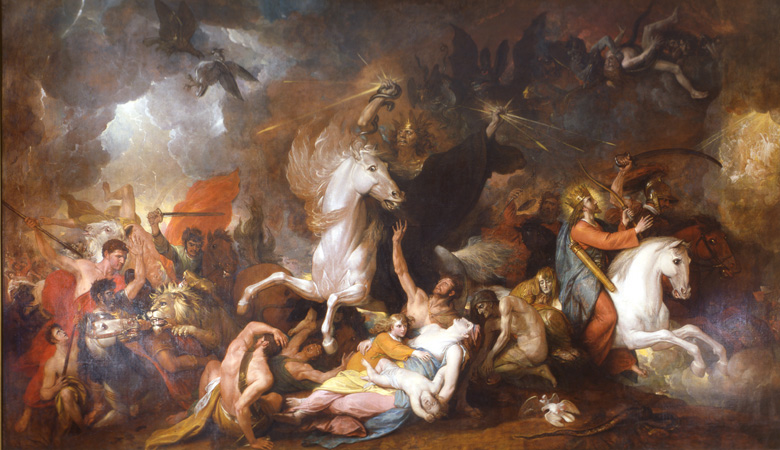
The final sentence refers to the painter Benjamin West, and presumably to paintings like his 1796 "Death on a Pale Horse."


On July 4, I like to think that "the seeds of the Declaration of Independence are yet maturing," with a full recognition that this process will not always provide its positive results through a happy cheerful parade of good feeling, but instead will sometimes be confrontational, wrenching, and difficult.

Edmund Burke: Six Reasons Why Americans Love Liberty

The British statesman and philosopher Edmund Burke gave a "Speech on Conciliation with the Colonies" on March 25, 1775. He sought to explain why those pesky Americans were so strident and obsessive about their love of freedom and liberty. He said:
"In this character of the Americans, a love of freedom is the predominating feature which marks and distinguishes the whole ... This fierce spirit of liberty is stronger in the English colonies probably than in any other people of the earth; and this from a great variety of powerful causes; which, to understand the true temper of their minds, and the direction which this spirit takes, it will not be amiss to lay open somewhat more largely."
Burke then proceeded to explain six causes why "a fierce spirit of liberty has grown up" in America. Here is my list of his six causes, with some snippets from his speech.

Cause #1: Seeing the power to control one's own taxes as as central part of liberty. 
They are therefore not only devoted to liberty, but to liberty according to English ideas, and on English principles. ... Liberty inheres in some sensible object; and every nation has formed to itself some favourite point, which by way of eminence becomes the criterion of their happiness. It happened, you know, Sir, that the great contests for freedom in this country were from the earliest times chiefly upon the question of taxing. Most of the contests in the ancient commonwealths turned primarily on the right of election of magistrates; or on the balance among the several orders of the state. The question of money was not with them so immediate. But in England it was otherwise. On this point of taxes the ablest pens, and most eloquent tongues, have been exercised; the greatest spirits have acted and suffered. ... The colonies draw from you, as with their life-blood, these ideas and principles. Their love of liberty, as with you, fixed and attached on this specific point of taxing. 
Cause #2: A love of popular representation in government. 
"Their governments are popular in a high degree; some are merely popular; in all, the popular representative is the most weighty; and this share of the people in their ordinary government never fails to inspire them with lofty sentiments, and with a strong aversion from whatever tends to deprive them of their chief importance."
Cause #3: Religious belief, and especially the Protestantism of the northern colonies
"Religion, always a principle of energy, in this new people is no way worn out or impaired; and their mode of professing it is also one main cause of this free spirit. The people are Protestants; and of that kind which is the most adverse to all implicit submission of mind and opinion. This is a persuasion not only favourable to liberty, but built upon it. ... All Protestantism, even the most cold and passive, is a sort of dissent. But the religion most prevalent in our northern colonies is a refinement on the principle of resistance; it is the dissidence of dissent, and the Protestantism of the Protestant religion. This religion, under a variety of denominations agreeing in nothing but in the communion of the spirit of liberty, is predominant in most of the northern provinces; where the Church of England, notwithstanding its legal rights, is in reality no more than a sort of private sect, not composing most probably the tenth of the people. The colonists left England when this spirit was high, and in the emigrants was the highest of all ... "
Cause #4: Those who live with slavery, especially in the southern colonies, tend to see liberty as more noble 
"It is, that in Virginia and the Carolinas they have a vast multitude of slaves. Where this is the case in any part of the world, those who are free, are by far the most proud and jealous of their freedom. Freedom is to them not only an enjoyment, but a kind of rank and privilege. Not seeing there, that freedom, as in countries where it is a common blessing, and as broad and general as the air, may be united with much abject toil, with great misery, with all the exterior of servitude, liberty looks, amongst them, like something that is more noble and liberal. I do not mean, Sir, to commend the superior morality of this sentiment, which has at least as much pride as virtue in it; but I cannot alter the nature of man. The fact is so; and these people of the southern colonies are much more strongly, and with a higher and more stubborn spirit, attached to liberty, than those to the northward. ... In such a people, the haughtiness of domination combines with the spirit of freedom, fortifies it, and renders it invincible."
Cause #5: Lots of lawyers, and lawyerly thinking. 
"In no country perhaps in the world is the law so general a study. The profession itself is numerous and powerful; and in most provinces it takes the lead. The greater number of the deputies sent to the congress were lawyers. But all who read, and most do read, endeavour to obtain some smattering in that science. ... This study renders men acute, inquisitive, dexterous, prompt in attack, ready in defence, full of resources. In other countries, the people, more simple, and of a less mercurial cast, judge of an ill principle in government only by an actual grievance; here they anticipate the evil, and judge of the pressure of the grievance by the badness of the principle. They augur misgovernment at a distance; and snuff the approach of tyranny in every tainted breeze."
Cause #6: Geographical distance from England encourages thoughts of liberty. 
"Three thousand miles of ocean lie between you and them. No contrivance can prevent the effect of this distance in weakening government. Seas roll, and months pass, between the order and the execution; and the want of a speedy explanation of a single point is enough to defeat a whole system. ...  In large bodies, the circulation of power must be less vigorous at the extremities. Nature has said it.  ... Spain, in her provinces, is, perhaps, not so well obeyed as you are in yours. She complies too; she submits; she watches times. This is the immutable condition, the eternal law, of extensive and detached empire."
Burke points out that the issue was not whether these arguments were virtuous or moral, or whether the American spirit of liberty was in some way unreasonable or excessive. When faced with the reality of liberty-loving Americans was what to do:
"I do not mean to commend either the spirit in this excess, or the moral causes which produce it. Perhaps a more smooth and accommodating spirit of freedom in them would be more acceptable to us. Perhaps ideas of liberty might be desired, more reconcilable with an arbitrary and boundless authority. Perhaps we might wish the colonists to be persuaded, that their liberty is more secure when held in trust for them by us (as their guardians during a perpetual minority) than with any part of it in their own hands. The question is, not whether their spirit deserves praise or blame, but--what, in the name of God, shall we do with it?"
Obviously, Burke's six reasons apply to the time and place in which he was writing, but it seems to me that they they have echoes in the American character that persist.

For example, Americans continue to have a intense focus on taxation. The idea of direct representation of people in government is a civic religion (especially when it feels as if it is not being properly accomplished). For many Americans, of all faith traditions, their religion is in some way "a refinement on the principle of resistance; it is the dissidence of dissent." The aftermath of American slavery has made the call of "freedom" perhaps even stronger. Public gatherings often involve broad claims about desirability of freedom, and the sense that people are in some way being denied their freedom. The country is full of lawyerly thinkers who are "acute, inquisitive, dexterous, prompt in attack, ready in defence, full of resources," and who "augur misgovernment at a distance; and snuff the approach of tyranny in every tainted breeze." And the geographic location (and sheer size) of the United States means that American liberty is not under threat from neighboring countries in the way that is experienced by people in so much of the world.

On July 4, it's worth noting some of these continuities and divergences in the American experience. And in looking ahead, one can do worse that repeat Burke's question: The question is, not whether their spirit deserves praise or blame, but--what, in the name of God, shall we do with it?"

Monday, July 2, 2018

Black-White Income and Wealth Gaps

Black-white gaps in income and in wealth have been fearsomely persistent over time. Here, I'll mention some main themes from two studies, one focused on income differentials and one on wealth differentials.  

On the topic of income differentials, Raj Chetty, Nathaniel Hendren, Maggie R. Jones, and Sonya R. Porter have written a research paper, "Race and Economic Opportunity in the United States:An Intergenerational Perspective" (March 2018, also available as NBER Working Paper #24441). The authors have written a nice readable summary of main findings for the VoxEU website (June 27, 2018).

But before listing those findings, it's perhaps interesting to note the data on which the study is based, because it represents a new kind of empirical work that has become possible in the social sciences, which draws on extremely large datasets that are linked together, but in a way where the names and identifying characteristics of individuals are blocked from the researchers. Thus this study uses "newly-available longitudinal data from the U.S. Census Bureau that covers virtually the entire American population from 1989-2015. ... [W]e use de-identified data from the 2000 and 2010 decennial Censuses linked to data from federal income tax returns and the 2005-2015 American Community Surveys to obtain information on income, race, parental characteristics, and other variables. We focus on children in the 1978-1983 birth cohorts who were born in the U.S. or authorized immigrants who came to the U.S. in childhood. Our primary analysis sample consists of 20 million children, approximately 94% of the total number of children in the birth cohorts we study. ... [W]e characterize intergenerational gaps by race. We measure children’s incomes as their mean household income in 2014-15, when they are in their mid-thirties. We measure their parents’ income as mean household income between 1994 and 2000, when their children are between the ages of 11 and 22."
In short, this is a very large and very detailed sample of what happened to this particular generation of children. For key findings, I'll just quote from the authors of the study in their VoxEU piece--but there is more detail and illustrative figures there.
Finding #1: Hispanic Americans are moving up in the income distribution across generations, while Black Americans and American Indians are not. ...
In contrast, black and American Indian children have substantially lower rates of upward mobility than the other racial groups. For example, black children born to parents in the bottom household income quintile have a 2.5% chance of rising to the top quintile of household income, compared with 10.6% for whites.

Growing up in a high-income family provides no insulation from these disparities. American Indian and black children have much higher rates of downward mobility than other groups. Black children born to parents in the top income quintile are almost as likely to fall to the bottom quintile as they are to remain in the top quintile. By contrast, white children born in the top quintile are nearly five times as likely to stay there as they are to fall to the bottom. ...
Finding #2: The black–white income gap is entirely driven by differences in men’s, not women’s, outcomes. ...
Finding #3: Differences in family characteristics – parental marriage rates, education, wealth – and differences in ability explain very little of the black–white gap. ...
Finding #4: In 99% of neighbourhoods in the United States, black boys earn less in adulthood than white boys who grow up in families with comparable income.
One of the most prominent theories for why black and white children have different outcomes is that black children grow up in different neighbourhoods than whites. But, we find large gaps even between black and white men who grow up in families with comparable income in the same Census tract (small geographic areas that contain about 4,250 people on average). Indeed, the disparities persist even among children who grow up on the same block. These results reveal that differences in neighbourhood-level resources, such as the quality of schools, cannot explain the intergenerational gaps between black and white boys by themselves. Black–white disparities exist in virtually all regions and neighbourhoods. Some of the best metro areas for economic mobility for low-income black boys are comparable to the worst metro areas for low-income white boys, ...
Finding #5: Both black and white boys have better outcomes in low-poverty areas, but black-white gaps are bigger in such neighbourhoods. ...
Finding #6: Within low-poverty areas, black–white gaps are smallest in places with low levels of racial bias among whites and high rates of father presence among blacks. ...
Finding #7: The black–white gap is not immutable: black boys who move to better neighbourhoods as children have significantly better outcomes.

On the issues of black-white inequality in wealth, William Darity Jr., Darrick Hamilton, Mark Paul, Alan Aja, Anne Price, Antonio Moore, and Caterina Chiopris offer an overview of some key findings in "What We Get Wrong About Closing the Racial Wealth Gap" (April 2018, Samuel DuBois Cook Center on Social Equity at Duke University). The report is in the form of myths and then counterpoint evidence drawn from a variety of sources. Again, there is much more evidence and argument in the report, but here are some main findings (citations and footnote omitted for readability).
Myth 1: Greater educational attainment or more work effort on the part of blacks will close the racial wealth gap. ...
At every level of educational attainment, black families’ median wealth is substantially lower than their white counterparts. White households with a bachelor’s degree or post-graduate education (such as with a Ph.D., MD, and JD) are more than three times as wealthy as black households with the same degree attainment. Moreover, on average, a black household with a college-educated head has less wealth than a white family whose head did not even obtain a high school diploma. It takes a post-graduate education for a black family to have comparable levels of wealth to a white household with some college education or an associate degree ...
As one would expect, the median household wealth is higher for employed families than for unemployed families in both races. However, white households with an employed head have more than ten times higher wealth than similar black households. Furthermore, white households with an unemployed head have a higher net worth than black households with a head who is working full time.
Myth 2: The racial homeownership gap is the “driver” of the racial wealth gap. ...
For those households who do not own a home, wealth levels are low for both white and black households; however black non-homeowner households have a mere $120 in net worth – insufficient to feed a family for a week. The data indicates that white households who are not home-owners hold 31-times more wealth than black households that do not. Among households that own a home, white households have nearly $140,000 more in net worth than comparable black households. ...
Myth 3: Buying and banking black will close the racial wealth gap. ...
Black-owned banks also are miniscule in the context of the general scale of American banking. The largest five black owned banks recently were estimated to have assets totaling $2.3 billion, while J.P. Morgan alone had an estimated $2 trillion in assets. Thus, the top five black banks’ assets were a tiny 0.1 percent of Morgan’s assets (Fontinelle 2017). This indicates that the existing infrastructure of black-owned banks lacks the capacity to produce wide and substantial increases in black wealth. ...
Myth 4: Black people saving more will close the racial wealth gap. ...
[T]here is no evidence that black Americans have a lower savings rate than white Americans once household income is taken into account ...
Myth 5: Greater financial literacy will close the racial wealth gap...
The problem with assigning differences in cost of finance and asset portfolios to difference in financial acumen is its directional emphasis. Meager economic circumstances—not poor decision making or deficient knowledge—constrain choices and leave asset-poor borrowers with little to no other option but to use predatory and abusive alternative financial services. A negligible level of economic resources readily explains why blacks, specifically, use more predatory financial institutions. ...
Myth 6: Entrepreneurship will close the racial wealth gap. ....
When we compile the data even those members of marginalized communities who manage to enter into entrepreneurship largely fail. This is due to a number of factors ranging from under-capitalization, limited market access, or outright theft or destruction. Blacks are far less likely to own a business, and for blacks that do own a business they have far less equity. ... In reality the data paints a daunting picture for diversity in entrepreneurship. According to the U.S. Census Bureau’s Survey of Business Owners (SBO), which is conducted every five years, over 90 percent of Latino and black firms do not have even one employee other than the owner. The proportion of owner only firms reaches a high of close to 98 percent for the sub-group of black female led businesses. When blacks do own a business the return to that business is lower than that of whites and falls well short of closing the racial wealth gap. ... No amount of tutorials or online courses from wealth experts can change the reality of the racialized advantages and disadvantages that undergird entrepreneurship in America. ...
Myth 7: Emulating successful minorities will close the racial wealth gap. ...
In short, so-called “successful” immigrant groups actually retrieve a comparable class position as the one they held in their country of origin. Their pre-migration capital, whether embodied in their education and training or their financial resources, is critical in determining their outcomes in the United States. ... In short, the argument that intergroup disparities in wealth are borne out of group based cultural/behavioral deficiencies is misleading and misdirected. Instead, we should focus on the long exposure of low wealth racial/ethnic groups to theft of wealth and blockades on wealth accumulation. To suggest that blacks and racialized Latino, and Native Americans should emulate other supposedly successful “minority” groups perpetuates the false narrative that their asset poverty is due to a lack of hard work, effort, or ambition. ...
Myth 8: Improved “soft skills” and “personal responsibility” will close the racial wealth gap.
Black men already are largely located in service sector jobs that require, or depend, on “soft-skills.” It is not “soft skills” requirements that distinguish black and white male sites of employment. It is relatively lower pay in the jobs held by the former and relatively higher pay in jobs held by the latter ... While some individuals can indeed “get ahead” or “beat the odds,” the larger structural conditions, well-document wage and unemployment gaps, demonstrate that even when black people “do the right thing”, it does not close the racial wealth gap.
Myth 9: The growing numbers of black celebrities prove the racial wealth gap is closing. ...
Unfortunately, from “The Cosby Show” to Michael Jackson’s multi-platinum albums to Will Smith’s meteoric rise to the present day mega couple Jay-Z and Beyoncé, black celebrity has masked black poverty, rather than contributed to closing the racial wealth gap. No ethnic or racial group-- not Asians, not Latinos, and not whites -- has been framed so dramatically through celebrity status as black Americans. Despite recently released 2016 Federal Reserve data showing that the median black family has a net worth of about $17,600, while the median white family has a net worth closer to $170,000 (Jan 2017), black life has come to be seen through the lens of radically exceptional cases, rather than typical ones.
Myth 10: Black family disorganization is a cause of the racial wealth gap. ...
However, marriage does little to help equalize wealth among white and black women with a college degree. For example, married white women without a bachelor’s degree are in households where they have more than two and a half times the wealth of married black women with a degree. Racial wealth disparities widen among married women with a bachelor’s degree; married white women are in households that have more than five times the amount of wealth as their black counterparts. White households with a single white parent have more than two times the net worth of two parent black households ...
There are of course lots of questions one can raise about specific findings in this body of research, or raise questions about underlying causes and policy options. Studying the trees is worthwhile but one shouldn't lose sight of the forest. African-American households are experiencing real and severe economic disadvantages in the US economy. 

Friday, June 29, 2018

The Problem of College Completion Rates

There's one event that very often turns college enrollment into a poor financial decision with a negative payoff: not completing a degree. Then that happens, the student has spent both money and some years of time in a program that not only offers little financial payoff, but may also leave them saddled with student loans to repay for years to come. More broadly, society's investment in higher education isn't paying off. Two DC think-tanks, ThirdWay and the American Enterprise Institute, have published a set of  five readable papers on the subject:


Bridget Terry Long offers a nice overview of the problem She writes:
"The conventional way to measure graduation rates is to examine how many students complete a degree within 150 percent of the expected completion time—that is, six years for a bachelor’s degree and three years for an associate degree. Using this metric, research suggests that about only half of students enrolled at four-year colleges and universities graduate within 150 percent of the expected completion time, and the completion rate is even lower for students enrolled at two-year colleges."
Here's a table from her paper showing college completion rates across different types of institujtions by this measure.
Sarah Turner's essay offers some additional in-depth background. On the  horizontal axis, these graphs show spending per student. On the vertical axis, they show completion rates (again, as measured by completing a degree within 150% of the expected time) Each dot is a college or university. The central insight is that there is a very wide range of completion rates across schools in the same category that spend much the same amount per student.
Turner writes:
"In 43 four-year public schools, the three-year cohort default rate is greater than the completion rate. This is also the case for 147 four-year private nonprofit schools and 98 for-profit schools. In other words, students in these schools who borrow face a greater likelihood of defaulting than completing a degree. It would seem, then, that college attendance at these schools leaves many students worse off—lacking a degree, defaulting on a student loan, or both."
The papers tend to be stronger on describing the problem than on providing clearly workable solutions, but that's the nature of this issue. College completion rates have been low for a long time, but with the cost of college now having climbed so very high, the issue has a new relevance. For example, Destin looks at how improvements in the psychological environment at a school, including elements of teaching and campus life, can help. Chingos emphasizes that students need preparation to be ready to do college-level work. Turner discusses the pros and cons of linking college completion rates and the levels of state support and financial aid.  Schneider and Clark summarize reforms that have improve completion rates at certain schools. 

One challenge here is to remember that the ultimate goal isn't to punish schools with low completion rates (although that may be necessary in some cases). It's to have fewer students falling off the path to college completion.