Monday, August 15, 2016

Alfred Marshall and the Origin of Ceteris Paribus

When non-economists ask me questions, they often seem to be jumping from topic to topic. A question about the effects of raising the minimum wage, for example, shifts from how it will affect jobs, and earnings, and companies that hire minimum wage workers, and work effort, and automation, and the the overall income distribution, and children of minimum wage earners, and so on. The questions are all reasonable. But I become self-aware that economists have trained themselves into a one-thing-at-a-time method of analysis, and so bouncing from one topic to another can feel somehow awkward.

The ceteris paribus or "other things equal" assumption involves an intellectual approach, common among economists, of trying to focus on one thing at a time. After all, many economic issues and policies have a number of possible causes and effects. Rather than hopscotching among them, economists often try to discuss isolate one factor at a time, and then to move on to other factors, before combining it all into an overall perspective. The use of this approach in economic analysis traces back to trace back to Alfred Marshall's 1890 classic Principles of Economic Analysis.

The Library of Economics and Liberty provides a useful place for finding searchable editions of many classic works in economics. The site provides the 8th edition of Marshall's Principles, published in 1920. In Book V, Chapter V, "Equilibrium of Normal Demand and Supply, Continued, With Reference To Long and Short Periods," Marshall described the overall logic of looking at one thing at a time, offers some hypothetical examples from a discussion of supply and demand shocks in fish markets, and points out that longer the time period of analysis, the harder it becomes to assume that everything else is constant. Marshall writes:
"The element of time is a chief cause of those difficulties in economic investigations which make it necessary for man with his limited powers to go step by step; breaking up a complex question, studying one bit at a time, and at last combining his partial solutions into a more or less complete solution of the whole riddle. In breaking it up, he segregates those disturbing causes, whose wanderings happen to be inconvenient, for the time in a pound called Cœteris Paribus. The study of some group of tendencies is isolated by the assumption other things being equal: the existence of other tendencies is not denied, but their disturbing effect is neglected for a time. The more the issue is thus narrowed, the more exactly can it be handled: but also the less closely does it correspond to real life. Each exact and firm handling of a narrow issue, however, helps towards treating broader issues, in which that narrow issue is contained, more exactly than would otherwise have been possible. With each step more things can be let out of the pound; exact discussions can be made less abstract, realistic discussions can be made less inexact than was possible at an earlier stage. ...

The day to day oscillations of the price of fish resulting from uncertainties of the weather, etc., are governed by practically the same causes in modern England as in the supposed stationary state. The changes in the general economic conditions around us are quick; but they are not quick enough to affect perceptibly the short-period normal level about which the price fluctuates from day to day: and they may be neglected [impounded in cœteris paribus] during a study of such fluctuations.

Let us then pass on; and suppose a great increase in the general demand for fish, such for instance as might arise from a disease affecting farm stock, by which meat was made a dear and dangerous food for several years together. We now impound fluctuations due to the weather in cœteris paribus, and neglect them provisionally: they are so quick that they speedily obliterate one another, and are therefore not important for problems of this class. And for the opposite reason we neglect variations in the numbers of those who are brought up as seafaring men: for these variations are too slow to produce much effect in the year or two during which the scarcity of meat lasts. Having impounded these two sets for the time, we give our full attention to such influences as the inducements which good fishing wages will offer to sailors to stay in their fishing homes for a year or two, instead of applying for work on a ship. We consider what old fishing boats, and even vessels that were not specially made for fishing, can be adapted and sent to fish for a year or two. The normal price for any given daily supply of fish, which we are now seeking, is the price which will quickly call into the fishing trade capital and labour enough to obtain that supply in a day's fishing of average good fortune; the influence which the price of fish will have upon capital and labour available in the fishing trade being governed by rather narrow causes such as these. This new level about which the price oscillates during these years of exceptionally great demand, will obviously be higher than before. Here we see an illustration of the almost universal law that the term Normal being taken to refer to a short period of time an increase in the amount demanded raises the normal supply price.  ...

Relatively short and long period problems go generally on similar lines. In both use is made of that paramount device, the partial or total isolation for special study of some set of relations. In both opportunity is gained for analysing and comparing similar episodes, and making them throw light upon one another; and for ordering and co-ordinating facts which are suggestive in their similarities, and are still more suggestive in the differences that peer out through their similarities. But there is a broad distinction between the two cases. In the relatively short-period problem no great violence is needed for the assumption that the forces not specially under consideration may be taken for the time to be inactive. But violence is required for keeping broad forces in the pound of Cateris Paribus during, say, a whole generation, on the ground that they have only an indirect bearing on the question in hand. For even indirect influences may produce great effects in the course of a generation, if they happen to act cumulatively; and it is not safe to ignore them even provisionally in a practical problem without special study. Thus the uses of the statical method in problems relating to very long periods are dangerous; care and forethought and self-restraint are needed at every step. The difficulties and risks of the task reach their highest point in connection with industries which conform to the law of Increasing Return; and it is just in connection with those industries that the most alluring applications of the method are to be found.
For those who want more on the history of ceteris paribus (the modern spelling no longer uses the ligature version that ties together the o and e), Joseph  Persky offers a nice introduction in his 1990 article "Retrospectives: Ceteris Paribus," which appeared in the Journal of Economic Perspectives (4: 2, pp. 187-193). Persky finds early uses of the term back in the 1600s, including a 1662 passage by the economist William Petty that was often quoted in the 19th century--and thus may have inspired Marshall's use of the term. 

Persky notes the dueling concerns that economists may in some cases feel that they should avoid big-picture subjects in the global economy or historical analysis because the ceteris are not always paribus, or in other cases that economic research may be focusing on one factor while other important factors are also changing. But as Persky points out, the ceteris paribus assumption is not meant as a literal statement that nothing else has changed, but only to remind the reader that the analysis may be leaving something out. As Persky writes: "Economists could do much worse than to flag our fallibility with a bit of Latin."

Friday, August 12, 2016

The Future of DSGE Models in Macroeconomics

One of the hardest problems in studying the macroeconomy is that time keeps advancing. You can't go back to, say, 2001 or 2009, not enact the Bush tax cuts or the Obama economic stimulus, and then re-run the economy and see what happens. Instead, researchers end up comparing effects of seemingly similar policies enacted at different times--but the policies and the circumstances are never quite identical, so room for dispute remains. Indeed, disagreements among macroeconomists are nearly proverbial. "Macroeconomists have predicted nine of the last five recessions." "Two macroeconomists, five opinions." "Economists are the experts who explain why the prediction they made yesterday didn't come true today."

I sometimes receive notes from readers asking for a sense of why macroeconomists disagree.  Olivier Blanchard opens up some of the central issues for useful discussion in a short and readable paper, "Do DSGE Models Have a Future?" written for the Peterson Institute for International Economics (Policy Brief 16-11, August 2016).

For the uninitiated, DSGE models of the macroeconomy are a method that is both well-established and the stuff of continuing controversy. DSGE stands for "dynamic stochastic general equilibrium model," which represents a broad class of macroeconomic models. In the jargon, "dynamic" means that the models show the evolution of a (hypothetical) economy over time. "Stochastic" means that the models show how the economy would respond if certain shocks occur, whether the shocks involve policy choices or economic events (like a rise or fall in the rate of productivity growth). "General equilibrium" means that these models don't look at the macroeconomy one sector at a time--say, first consumption, then investment, then foreign trade--but instead try to take all the interactions of these sectors into account.  Blanchard describes the models in this way:
"For those who are not macroeconomists, or for those macroeconomists who lived on a desert island for the last 20 years, here is a brief refresher. DSGE stands for “dynamic stochastic general equilibrium.” The models are indeed dynamic, stochastic, and characterize the general equilibrium of the economy. They make three strategic modeling choices: First, the behavior of consumers, firms, and financial intermediaries, when present, is formally derived from microfoundations. Second, the underlying economic environment is that of a competitive economy, but with a number of essential distortions added, from nominal ties to monopoly power to information problems. Third, the model is estimated as a system, rather than equation by equation in the previous generations of macroeconomic models. ... [C]urrent DSGE models are best seen as large scale versions of the New Keynesian model, which emphasizes nominal rigidities and a role for aggregate demand."
Blanchard gives four main concerns about DSGE models along with some thoughts about each one. Thus, he writes:
There are many reasons to dislike current DSGE models. First: They are based on unappealing assumptions. Not just simplifying assumptions, as any model must, but assumptions profoundly at odds with what we know about consumers and firms.  ... Second: Their standard method of estimation, which is a mix of calibration and Bayesian estimation, is unconvincing. ... Third: While the models can formally be used for normative purposes, normative implications are not convincing. ... Fourth: DSGE models are bad communication devices. A typical DSGE paper adds a particular distortion to an existing core. It starts with an algebra-heavy derivation of the model, then goes through estimation, and ends with various dynamic simulations showing the effects of the distortion on the general equilibrium properties of the model. "
You can read the details of Blanchard's responses in the paper, but I'd characterize his overall Blanchard's view of DSGE models seems to be negative, ambivalent, and  positive all at the same time. He writes: "I see the current DSGE models as seriously flawed, but they are eminently improvable and central to the future of macroeconomics." A snippet of his more detailed answer like this:
The pursuit of a widely accepted analytical macroeconomic core, in which to locate discussions and extensions, may be a pipe dream, but it is a dream surely worth pursuing. If so, the three main modeling choices of DSGEs are the right ones. Starting from explicit microfoundations is clearly essential; where else to start from? Ad hoc equations will not do for that purpose. Thinking in terms of a set of distortions to a competitive economy implies a long slog from the competitive model to a reasonably plausible description of the economy. But, again, it is hard to see where else to start from. Turning to estimation, calibrating/estimating the model as a system rather than equation by equation also seems essential. Experience from past equation-by-equation models has shown that their dynamic properties can be very much at odds with the actual dynamics of the system. 
It's worth unpacking this a bit. Blanchard's comment that the DSGE approach "may be a pipe dream, but it is a dream surely worth pursuing," is not calculated to inspire confidence in the results of such studies! This intellectual agenda involves modelling activities of real-world economic actors, including various assumptions and some combination of rational choice and behavioral economics, involves many possible choices. The selection of possible frictions like monopoly power, wages and prices which adjust in a sticky manner, the formation of expectations, the issue raised by financial markets, all adds another set of possible choices. The question of how to get a workable quantatitive number out of this model involves choosing some plausible values from other studies (that is, "calibrating" the model) and what parts of the model to estimate using data involves still more choices.

In addition, Blanchard discusses how DSGE modelling needs to be open to new insights from behavioral economics, from the use of big data, from issues about problems that can arise in financial markets, and more. He also suggests: "At one end, maximum theoretical purity is indeed the niche of DSGEs. For those models, fitting the data closely is less important than clarity of structure." This comments is not calculated to inspire confidence in the results of such studies either. He suggests that there is also a need for one set of related-but-different studies for policy purposes, and another set of related-but-different models for puruposes economic forecasting, and still other lessons that are most accessible through simpler ad hoc models (like the IS-LM model from intermediate-level macro textbooks).

In a way, what macroeconomists have been learning in the last few decades is to reach a deeper understanding how many different ingredients might be included in a macroeconomic model. But no model can look at everything at once, so macroeconomists are always trying to figure out which ingredients matter most. My own takeaway is that DSGE models will continue to matter a lot to high-powered researchers in macroeconomics, like Blanchard. But for the rest of us, the task is to keep track of how insights from those models filter down through the research literature and become practical lessons that can be explained and applied in more stripped-down contexts.

Thursday, August 11, 2016

US Motor Vehicle Deaths:

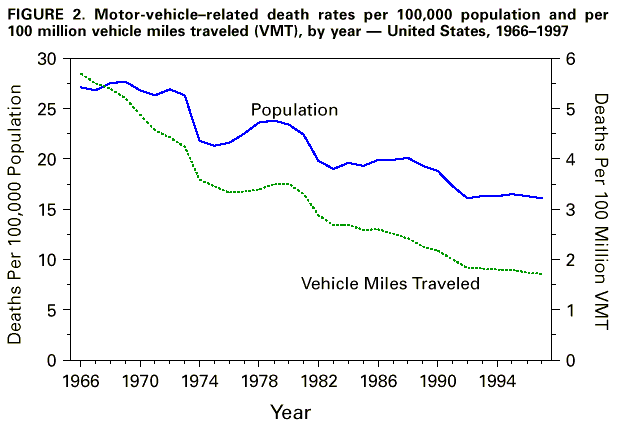
The United States has made enormous strides in reducing motor vehicle deaths--and even so, a higher percentage of Americans die on the road than in other other high-income countries. Plausible estimates suggest that reducing drunk driving and increasing seat belt use in the US to levels that commonly prevail in other high-income countries could save thousands of lives each year.

Here's an article from 1999 showing the fall in US motor vehicle deaths from the mid-1960s up through the end of the 20th century.  US Motor vehicle deaths per million miles travelled fall by about two-thirdd during this time.

Figure 2
Even though this decline in US motor vehicle deaths has continued, it's happening faster in other high income countries. Erin K. Sauber-Schatz, David J. Ederer,; Ann M. Dellinger, and Grant T. Baldwin offers some comparisons in "Vital Signs: Motor Vehicle Injury Prevention — United States and 19 Comparison Countries," which appears in Morbidity and Mortality Weekly Report, July 6, 2016, published by the Centers for Disease Control. They write:
"In 2013, the United States motor vehicle crash death rate of 10.3 per 100,000 population had decreased 31% from the rate in 2000; among the 19 comparison countries, the rate had declined an average of 56% during this time. Among all 20 countries, the United States had the highest rate of crash deaths per 100,000 population (10.3); the highest rate of crash deaths per 10,000 registered vehicles (1.24), and the fifth highest rate of motor vehicle crash deaths per 100 million vehicle miles traveled (1.10). Among countries for which information on national seat belt use was available, the United States ranked 18th out of 20 for front seat use, and 13th out of 18 for rear seat use. Among 19 countries, the United States reported the second highest percentage of motor vehicle crash deaths involving alcohol-impaired driving (31%), and among 15, had the eighth highest percentage of crash deaths that involved speeding (29%). ...

"If the United States had the same motor vehicle crash death rate as Belgium (the country with the second highest death rate), 12,000 fewer lives would have been lost in 2013 and an estimated $140 million in direct medical costs would have been averted. Similarly, if the United States’ motor vehicle crash death rate was equivalent to the average in the 19 comparison countries, at least 18,000 fewer lives would have been lost and an estimated $210 million in direct medical costs would have been averted."
As the authors are careful to note, these comparisons are in some sense quick-and-dirty (my phrase, not theirs!). Countries differ in how they collect this kind of data, what the rules are that govern whether a driver is intoxicated, the quality of their roads, other rules they impose about driving (like speed limits) and in other ways. But given that there are a range of possible enforcement policies  and ways of investing in safer roads that could plausibly save more than 10,000 American lives per year, surely this is a worthwhile cause for someone to take up?

Something about reducing motor vehicle deaths just isn't politically sexy. It sounds like nagging. One can almost hear the argumentative hypothetical response: "Hey, if I want to drive without a seat-belt and take a risk of killing myself, it's nobody else's business." But friends and loved ones might disagree. Those who die because someone else was driving drunk or texting or on an unsafe road would surely disagree. And we don't get a chance to hear the opinions of those who are already dead.

Wednesday, August 10, 2016

Is Support for Democracy Eroding?

"In the past three decades, the share of U.S. citizens who think that it would be a “good” or “very good” thing for the “army to rule”—a patently undemocratic stance—has steadily risen. In 1995, just one in sixteen respondents agreed with that position; today, one in six agree. While those who hold this view remain in the minority, they can no longer be dismissed as a small fringe, especially since there have been similar increases in the number of those who favor a “strong leader who doesn’t have to bother with parliament and elections” and those who want experts rather than the government to “take decisions” for the country. Nor is the United States the only country to exhibit this trend. The proportion agreeing that it would be better to have the army rule has risen in most mature democracies, including Germany, Sweden, and the United Kingdom."

Roberto Stefan Foa and Yascha Mounk lay out a variety of evidence on these themes in "The Democratic Disconnect," in which appears in the July 2016 issue of the Journal of Democracy (27:3, pp. pp. 5-17). Their opinion data is drawn from the World Values Survey, which relies on a network of social scientists, now active in about 100 countries around the world, who do surveys using a common set of questions.

Foa and Mounk offer a variety of detailed insights into attitudes about democracy: here, I'll just  highlight a few results that caught my eye. One is that the lower support for democracy seems especially high among younger adults. The horizontal axis on this figure shows the decade in which people were born: thus, older respondents are on the left and younger respondents are on the right. In both the US and in Europe, young adults have become less likely to say that it is "essential" to live in a democracy.


Conversely, the share of people saying that a democratic political system is a bad or a very bad way to run the country has risen since the mid-1990s, and this attitude is also more prevalent among younger adults.


In the US, the support for a "strong leader" who doesn't have to "bother with parliament and elections" has especially risen among those with higher income levels.

Foa and Mounk have a lot more to say in breaking down these patterns and trends. I'll only add that it seems to me that many people in the US and elsewhere are feeling the pull of what I call the "technocratic temptation." In this view, our economic, foreign policy, and social issues have clear-cut answers. If we would all just came together as a unified nation, put the appropriate technocratic experts in charge, and shut up those who disagree, then the experts could put those clear-cut answers into effect. My own view is that many deep problems don't have simple answers; while experts can be useful in contributing information and insight to social disputes, they can be at least as nutty in their social values and decision-making as anyone else; and ongoing disagreements on many issues should be viewed as healthy and productive, even though it means accepting that a certain number of issues will never be fully settled. For those who feel the need for an obligatory quotation here from John Stuart Mill, here's one.

Monday, August 8, 2016

Higher Local Minimum Wages: Early Results from Seattle

In June 2014, the city of Seattle passed a law raising the minimum wage for many employers in the city. The law went into effect on April 1, 2015, with an $11/hour minimum wage taking effect for many employers at that time, a $13/hour minimum wage scheduled to start in January 2016, and then ongoing rises up to $18/hour in years to come. A group called the  Seattle Minimum Wage Study Team, based at the University of Washington, is planning to study the effects of this rise in the minimum wage over time. The team investigators are Jacob Vigdor, Mark C. Long, Jennifer Romich, Scott W. Allard, Heather D. Hill, Jennifer Otten, Robert Plotnick, Scott Bailey, and Anneliese Vance-Sherman. It has now published a study on the first nine months of Seattle's higher minimum wage, in Report on the Impact of Seattle's Minimum Wage Ordinance on Wages, Workers, Jobs, and Establishments through 2015.

Perhaps the main difficulty in all minimum wage studies is the "compared to what?" question. If a minimum wage law is phased in over time and accompanied by higher wages, would a substantial portion of that rise in wages have happened anyway? If a minimum wage law is phased in over time and accompanied by fewer low-wage jobs, would a substantial portion of that decline in low-wage jobs have happened anyway (perhaps because of automation or other factors)?

One way to tackle the "compared to what?" question is to use comparison groups. Specifically, the Seattle study team looks at patterns of wages and jobs in Seattle before and after the rise in the minimum wage, and compares it to patterns to four other areas. Seattle is in King County, so one comparison is to King County outside Seattle.  A second comparison is to counties that surround King County, namely Snohomish, Kitsap, and Pierce. A third comparison is to  “synthetic Seattle,” which the researchers define "as a set of regions in the state of Washington that have matched Seattle’s labor market trends in recent years." A fourth comparison is “Synthetic Seattle excluding King County,” to account for potential spillover of the Seattle Minimum Wage Ordinance into labor market of suburban King County

As a starting point, the evidence shows that hourly wages for low-wage workers did rise in Seattle. At they write: "The typical worker earning under $11/hour in Seattle when the City Council voted to raise the minimum wage in June 2014 (“low-wage workers”) earned $11.14 per hour by the end of 2015, an increase from $9.96/hour at the time of passage."

However, the economy in Washington state was doing fairly well in 2015, and wages also rose in the comparison group areas. In describing the higher hourly wages in Seattle, the study team writes: "The minimum wage contributed to this effect, but the strong economy did as well. We estimate that the minimum wage itself is responsible for a $0.73/hour average increase for low-wage workers."

These findings for the wage paid per hour don't take into account possible changes in the number of hours worked. The study finds: " The minimum wage appears to have slightly reduced the employment rate of low-wage workers by about one percentage point. ... Hours worked among low-wage Seattle workers have lagged behind regional trends, by roughly four hours per quarter (nineteen minutes per week), on average. ... Low-wage individuals working in Seattle when the ordinance passed transitioned to jobs outside Seattle at an elevated rate compared to historical patterns. ... For businesses that rely heavily on low-wage labor, our estimates of the impact of the Ordinance ... on hours per employee more consistently indicate a reduction of roughly one hour per week."

Thus, low-wager workers in Seattle were better off as a result of the higher minimum wage if they managed to keep their job or to keep working roughly the same number of hours. But the employment rate of low-wage workers in Seattle declined slightly, as did the hours worked, which would lead to lower total earnings. As the study group notes: "The major conclusion one should draw from this analysis is that the Seattle Minimum Wage Ordinance worked as intended by raising the hourly wage rate of low-wage workers, yet the unintended, negative side effects on hours and employment muted the impact on labor earnings. ... The effects of disemployment appear to be roughly offsetting the gain in hourly wage rates, leaving the earnings for the average low-wage worker unchanged. Of course, we are talking about the average result."

Looking at the comparison groups, the study team doesn't find any effect of the first nine months of Seattle's higher minimum wage on business openings or closings: "We do not find compelling evidence that the minimum wage has caused significant increases in business failure rates. Moreover, if there has been any increase in business closings caused by the Minimum Wage Ordinance, it has been more than offset by an increase in business openings."

As the authors are at some pains to point out, it would be unwise to draw general conclusions about the minimum wage from a single study. The Seattle economy has specific characteristics during the period under study, which other urban areas may not share. The comparison economies are all in Washington state, and all have their own  specific characteristics, too. Looking at the effects of a city-level law and extrapolating to a state-level law or a national-level law can be problematic for a lot of reasons: for example, it's a lot easier for some employers paying minimum wage to expand in Seattle to shift operations to just outside the city border than it would be for them to shift outside the state border or the national border.

Moreover, some responses to a minimum wage might take time. For example, perhaps employers over time will find that hiring as many or more workers at the the higher minimum wage makes more economic sense than they had previously expected, perhaps because the higher wages bring less employee turnover or higher efficiency. Alternatively, perhaps employers over time will find more ways to substitute away from lower-wage workers in Seattle, using automation or having work done in other locations, and job losses traceable to the higher minimum wage will rise.

I'm willing to let the evidence tell me the story, and on many economic issues, it takes time for the evidence to accumulate. As more cities raise minimum wage, the picture will clarify. But the early evidence from Seattle is that a higher minimum wage at the city level doesn't raise total earnings by much, because low-skilled workers end up with fewer hours on the job.

Friday, August 5, 2016

Are Victims of War and Violence More Likely to Become Social Cooperators?

Economists are usually viewed as the skunk at the garden party--the ones who bring up difficult tradeoffs when everyone else just wants to view the world as all benefits and no costs. But a body of social science research is now suggesting that war, one of the most costly and brutal of human activities, does have at least one tradeoff on the positive side. Those who have experienced war seem somewhat more likely to increase their level of social participation and cooperation after the violence has ended. In "Can War Foster Cooperation?" Michal Bauer, Christopher Blattman, Julie Chytilová, Joseph Henrich, Edward Miguel, and Tamar Mitts review this evidence. The article appears in the just-released Summer 2016 issue of the Journal of Economic Perspectives.  They begin (citations omitted):
"Warfare leaves terrible legacies, from raw physical destruction to shattered lives and families. International development researchers and policymakers sometimes describe war as “development in reverse”, causing persistent adverse effects on all factors relevant for development: physical, human, and social capital. Yet a long history of scholarship from diverse disciplines offers a different perspective on one of the legacies of war. Historians and anthropologists have noted how, in some instances, war fostered societal transitions from chiefdoms to states and further strengthened existing states. Meanwhile, both economists and evolutionary biologists, in examining the long-run processes of institution-building, have also argued that war has spurred the emergence of more complex forms of social organization, potentially by altering people’s psychology. In this article, we discuss and synthesize a rapidly growing body of research based on a wealth of new data from which a consistent finding has emerged: people exposed to war violence tend to behave more cooperatively after war. We show the range of cases where this holds true and persists, even many years after war." 
The evidence on the after-effects of war on cooperation typically involves a survey component, in which people from a conflict-riven places like Sierra Leone, Uganda, Bosnia, Kosovo, and others are surveyed about the experience of their family in the war. For example, they might be asked questions like: "Were any members of your household killed during the conflict? Were any members injured or maimed during the conflict? Were any members made refugees during the war?" I

Evidence on social cooperation is then gathered in two forms. One is through additional survey data: that is, asking people about whether they now belong to clubs, vote, have an interest in politics, are active participants or leaders in community life, make voluntary contributions to public projects, and so on. The other is to have people participate in experimental games that seek to elicit attitudes toward cooperation.

Economists will be familiar with these games, like the ultimatum game, public goods game, and the like. Here are a couple of examples. the "dictator game" is one of the simplest of these games, in which one subject is given an amount to divide with another player. That's it! The player who is the "dictator" can keep it all, or give it all, and the amount they give can be viewed as a measure of likelihood to cooperation. In the more complex "trust game," the first player is given an amount to divide with another player. Whatever they give to that other player is multiplied by three. Then the second player gets to decide how much--if any--to return to the first player. When trust is higher, the first player will give more to the second player, in the hope or expectation of getting even more back.

The authors review 20 studies, and find that those who have been most exposed to the violence of war are more likely to show cooperative behaviors for years afterward. These effects seem especially strong when they are involved with players who in some way can be identified as members of their own group. I'll let you read the more detailed evidence for yourself, but it's perhaps worth noting one issue for any social science study. Is there some reason to believe that those who were more cooperative to begin with might also be more likely to suffer violence during wartime? The authors are fully aware of this argument,and write:

"For instance, more cooperative people might be more likely to participate in collective action, including civil defense forces or armed organizations that represent their groups during wartime, and thus more likely to live in a family that experiences some form of direct war victimization. Or perhaps attackers systematically target people who are likely to be more cooperative in nature, such as leading families or wealthy and influential citizens. If true, statistical tests would overstate the effect of war victimization on later civic participation and social capital. Attrition poses another potential challenge for causal identification if the least prosocial or cooperative people are also more likely to die, migrate, or be displaced and not return home."

The short answer to these concerns is that n many of these conflicts, it is frighteningly plausible that these direct experiences of violence were more-or-less randomly distributed across certain villages or populations. Thus, it is plausible that their higher cooperation is an after-effect of having experienced violence.

One intriguing question asked near the end of the paper is whether the effect of war-time violence on cooperation might also arise after other types of violence. The authors write (citations omitted):
"Another important direction is to examine other forms of physical insecurity, including crime, state repression, natural disaster, life-threatening accidents, and domestic abuse. In particular, the distinction between wartime violence and urban crime may not be large in certain cases, especially where widespread organized crime takes on characteristics of civil conflict, such as the cases of Mexican or Colombian drug trafficking organizations. Early evidence does indeed suggest that our findings on violence and cooperation could generalize to a wider range of situations. The meta-analysis finds that those who have experienced crime-related violence are also more likely to display cooperative behavior, just like war victims. There are parallels in related literatures, including findings that victims of crime are more likely to participate in community and political meetings, be interested in politics, and engage in group leadership. Other emerging evidence exploring the effects of post-election violence, and earthquake and tsunami damage also mimics the main finding of this paper, namely that survival threats tend to enhance local cooperation."
Of course, neither the authors nor anyone else is arguing that the costs of war and violence are offset by a modest if real improvement in cooperation. But as one considers the grim violence that stalks the lives of so many people around the world, any possible glimmer of light for the aftermath is welcome.

(Full disclosure: I'm the Managing Editor of JEP, and have been in that role since 1986. Since 2011, all JEP articles are freely available on-line compliments of the American Economic Association.)


Thursday, August 4, 2016

The Global Tourism Industry

International tourism is an enormous industry, representing $1.5 trillion per year in revenues and about 7% of total world exports of goods and services in 2015. The UN World Tourism Organization has published its "Tourism Highlights 2016" with a number of background facts.

International tourist arrivals reached 1.2 billion in 2015, and are projected by the UNWTO to rise by 50% in the next 15 years.

The main destinations of tourism are perhaps not much of a surprise. European countries rank highly, in part because of the number of trips from one European country to another. The US is a major destination. But there are some surprises. I would not necessarily have expected China to rank 4th, Turkey to rank 6th, or Russia to rank 10th around the world in tourist arrivals.

When it comes to countries sending tourists, China is far and away on top.
The UNWTO report is focused on numbers and trends, not on economic insights. But it provides food for thought. In high-income countries, many people have a standard of living where they can focus not just on buying goods and services for daily consumption, but on a "bucket list" of leisure experiences As more people around the world enter the global middle class, they often want to expand consumption of travel and tourism.

In an economic sense, tourism (both international and domestic) is a very large industry, and it is shaped by a mixture of policies toward visitors, ease of transportation and lodging, and a mixture of public and private amenities and destinations. When the US ranks behind France as a tourist destination, it suggests that the US is not doing what it could to facilitate tourism. For a number of lower-income and medium-income countries, one of their important economic questions is how to grow their tourism industry, and then how to incorporate the economic gains into gains in the standard of living for their economy. After all, many skills that facilitate tourism can help the economy in other ways, too, like reliable communications, logistics and scheduling, handling financial payments, clean water, electricity, transportation, and more. In a big-picture sense, I'm enough of an optimist to hope that the associations and connections that often result from international tourism can have a positive effect across countries and cultures, too.