Friday, September 6, 2019

US Multinationals Bring Foreign Earnings Back Home

The Tax Cuts and Jobs Act of 2017 largely eliminated taxes on US multinational corporations when they bring profits earned in other countries back to the use. As a result, there has been a dramatic rise in the dividends that U.S. parent companies received from their their foreign affiliates. Sarah A. Atkinson and Jessica McCloskey of the US Census Bureau offer some striking illustrations of this change, alnog with other data on international flows of investment in and out of the US economy,  in "Direct Investment Positions for 2018: Country and Industry Detail," published in the August 2019 Survey of Current Business

For example, here's a look at "outward direct investment" of US multinationals abroad. In any given year, the amount of outward direct investment can change for several reasons, but one key issue is whether earnings from other countries are reinvested abroad, or whether they are returned to the US. As the figure shows, US multinationals have been reinvesting about $300 billion per year in foreign earnings in other countries. In 2018, they instead brought almost $300 billion back to the US economy.
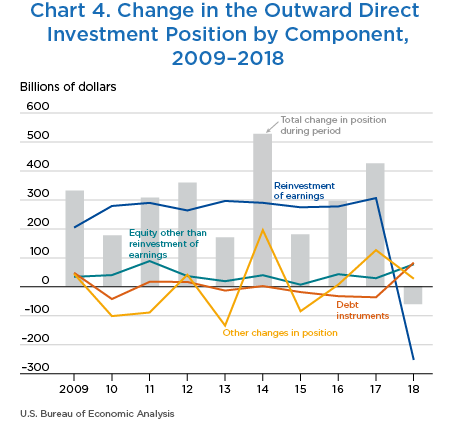
Chart 4. Change in the Outward Direct Investment Position by Component, 2009–2018. Line Chart.


Atkinson and Jessica McCloskey explain:
Reinvestment of earnings—the difference between the U.S. parents’ share of their foreign affiliates’ current-period earnings and dividends paid by the foreign affiliates to their U.S. parents—shifted to net inflows of $251.9 billion in 2018 from net outflows of $306.5 billion in 2017. The shift was largely due to the repatriation of accumulated prior earnings by U.S. multinationals from their foreign affiliates, largely in response to the TCJA [Tax Cuts and Jobs Act]. Current-period earnings of foreign affiliates of U.S. MNEs [multinational enterprises] can either be repatriated to the parent company in the United States in the form of dividends or reinvested in foreign affiliates. Dividends can be paid from either current-period earnings or prior-period earnings that had been reinvested. When dividends exceed current-period earnings, reinvested earnings (calculated as a residual) are negative, indicating a withdrawal of equity assets. In 2018, reinvestment of earnings of −$251.9 billion reflected the difference between direct investment earnings of $524.6 billion and dividends of $776.5 billion ..." 
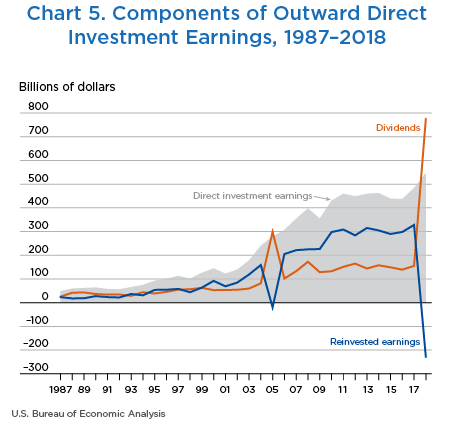
The figure below shows the pattern described in the previous text: that is, in 2018 total earnings of US multinationals on their foreign investments was $524.6 billion. However, total dividends paid to US corporate parents was $776.5 billion. Thus, the overall reduction in the stock of US foreign investment abroad was a drop of $251.9 billion.
Chart 5. Components of Outward Direct Investment Earnings, 1987–2018. Line Chart.

The authors also point out the countries from which these repayments to US corporate parents are arriving. They add:
Almost one-half of the dividends were from affiliates in Bermuda and the Netherlands, and the next largest share of dividends was from affiliates in Ireland. The largest increases in dividends by industry of U.S. parent were in the chemicals manufacturing, computers and electronic products manufacturing, and information industries. 
Of course, the actual physical location of US multinationals abroad is not mainly in Bermuda, Netherlands, and Ireland. Instead, these locations are where US multinationals have been holding large quantities of assets in an effort to reduce cases. For example, here's a discussion of the "Double Irish Dutch Sandwich" method for moving profits across international borders to reduce corporate taxes, and here's a broader discussion of "How US Multinationals Shifting Income to Foreign Countries Reduces Measured GDP."

As US multinationals bring home profits earned abroad, it will be interesting to track the results. Is some of the money paid out to shareholders? Will it be invested in new corporate projects, or will it be held as a liquid asset? Will this repatriation of profits affect stock market prices? 

Wednesday, September 4, 2019

Satellite Data Economics, Night Lights, and More

Many readers of this blog will have seen this versions of this satellite image many times, but it never fails to astonish me. The dark area outlined in red is North Korea. The rest of the peninsula below, illuminated, is South Korea.

I can quote you various statistics about how the economy of North Korea is estimated at something between $32 billion and $50 billion, with corresponding per capita income of either $1,238 or $1,700. Conversely, South Korea's GDP is $1,619 billion, with a per capita GDP of $31,362. But at least for me, the contrast between darkness and light provides its own gut-level understanding of how people experience big differences in economic growth.

Jiaxiong Yao provides this image and a discussion of the relationship between economic growth and night lights in "Illuminating Economic Growth: Satellite images of the earth at night reveal the pace of economic growth and much more," in  the September 2019 issue of Finance & Development.

Here's a less well-known but equally striking comparison. The upper image is Asia in 1992: you can see the outline of India on the left, China is in the middle, and to the right there is the dark/light contrast of the Korean peninsula, with Japan at the extreme right. The bottom image is the same frame of countries in 2013. The economic development of India and China is clear--and that image is from six years ago.


Yao points out that while night lights are broadly associated with economic development, the relationship isn't linear, and isn't the same everywhere.
The relationship between night lights and economic development, however, is not always straightforward. In my study with Johns Hopkins University’s Yingyao Hu, we compare night lights with GDP, the official and most commonly used measure of an economy’s performance. We find that rich countries are indeed brighter than less developed countries, but there is no lack of exceptions. On a per capita basis, Nordic countries have almost always been the brightest spots on Earth. On the other hand, Japan, despite being a rich country, looks scarcely brighter than Syria did before the Arab Spring, most likely because of its energy conservation habits and high population density.
Another pattern is that emerging market economies which are in the process of dramatically expanding power grids and transportation networks also look much brighter to satellites. However, high-income economies are mainly doing their growth through technology and innovation, which has less effect on light emissions. "In fact, night lights grow only about half as fast as GDP in advanced economies."

Night lights can also be used to estimate GDP in places where collection of economic statistics has broken down. 
There is probably nowhere on Earth where good economic data are scarcer than in countries afflicted by conflict—yet these economies are among the places we need to track and understand the most. Statistics agencies in these countries may have long stopped functioning properly, but satellites are still witnessing economic activity. It turns out that we can use night lights to reestimate the GDP of a conflict-stricken country, based on its similarities with other countries at various stages of development. When we do so, we find that the night-light-based GDP measure often points to faster economic deterioration during conflict than the official data show, but this measure also suggests a stronger bounce-back after the conflict ends.
For more analytical detail on connections from night lights to GDP, a useful starting point is the IMF Working Paper by Yingyao Hu and Jiaxiong, "Illuminating Economic Growth" (April 9, 2019)

It's also worth noting that satellite data shows a lot more than just night lights--indeed, more than just the visible spectrum. Thus, economists and other researchers are making increasing use of this data to look at a range of other issues including pollution, forest cover/deforestation, roofs/buildings in studies of urban development, cars/traffic. I offer a quick overview of this work, with some additional images, in "Economics and Satellite Data" (November 10, 2016). For a readable broader discussion of satellite data and how it can be used, see Dave Donaldson and Adam Storeygard, "The View from Above: Applications of Satellite Data in Economics," in the Fall 2016 issue of the Journal of Economic Perspectives (30:4, 171-98).

Tuesday, September 3, 2019

Nonrenewable Resources: The Pattern of Higher Extraction, Falling Prices

Here's an economic puzzle about nonrenewable resources, including energy resources but also minerals. One might expect that the least expensive locations for these resources would be exploited first. Thus, one might expect production costs for such resources to rise over time. If demand for such resources is also rising over time, intuition suggests that this combination should tend to raise prices for nonrenewables.

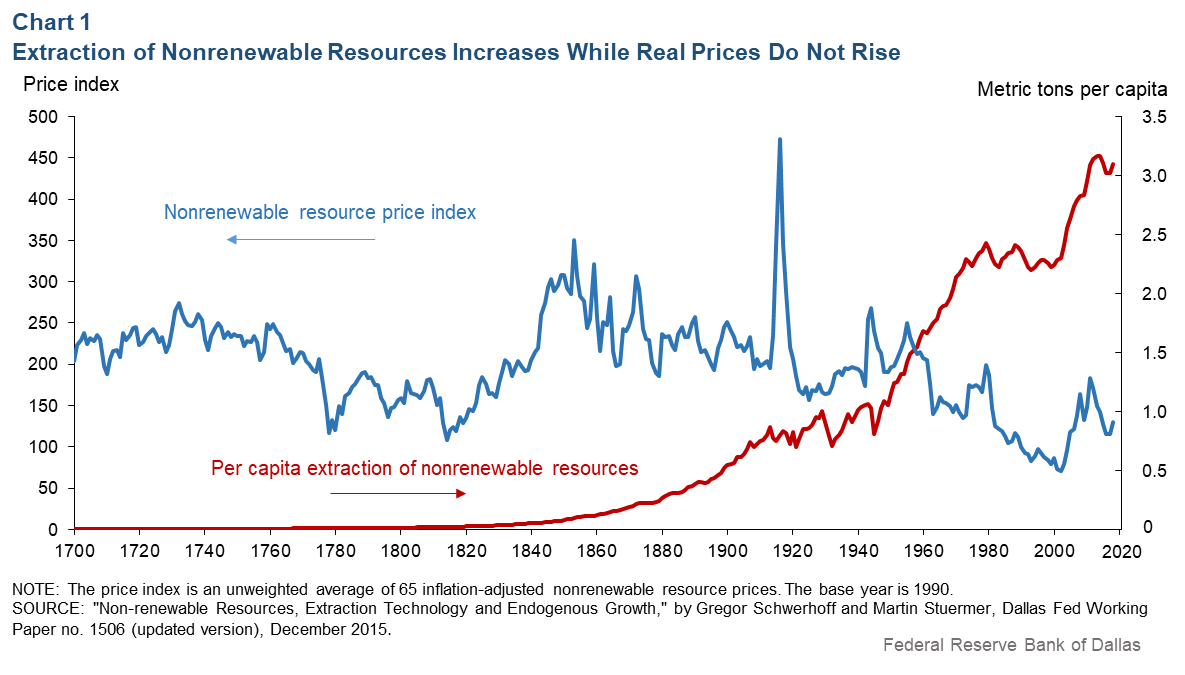
But this intuition is apparently wrong. Output of nonrenewable resources has risen substantially over the long-run, but prices have fallen.  Sean Howard, Gregor Schwerhoff and Martin Stuermer of the Federal Reserve Bank of Dallas discuss possible reasons in "Solving a Puzzle: More Nonrenewable Resources Without Higher Prices" (August 27, 2019). To set the stage, here is a chart where the red line shows combined extraction of 65 nonrenewable resources from 1700 to the present, and the blue line shows an index of the overall change in prices.

Chart 1: Extraction of Nonereweable REsources Increases While Real Prices Do Not Rise
Their proposed explanation is built on how new technologies for extracting nonrenewable resources interact with a common geological pattern. . They agree that when extracting nonrenewable resources, the least-expensive will tend to go first. However, it is a common geological pattern that there is relatively little of any resource that are easy to extract at low cost. As one moves to nonrenewable resources that can only be extracted at higher cost, there tend to be a greater quantity of these resources.

Because of this geological pattern, each new technology that comes along for reducing the cost of extracting nonrenewable resources tends to open up possibilities for accessing a greater quantity of such resources. They write:
L.H. Ahrens and his fundamental law of geochemistry states that greater quantities of a resource are locked in more troublesome lower grades, which in turn implies that a new technology’s higher development costs may be mitigated by the ever-greater supply of the resource it opens.
A practical example of this is the shale oil revolution in 2014. Although the development of hydraulic fracturing technology was most likely costlier than the development of earlier conventional methods, there is more unconventional oil. The International Energy Agency estimates there are 1.5 trillion barrels of crude oil in conventional or high-grade deposits and 4.5 trillion barrels in unconventional or low-grade deposits, including natural gas liquids. Although the technology required to extract unconventional oil is more expensive to develop, there is much more of the resource of this grade to
extract. 
The result of this interplay between extraction technology and geology is an equilibrium of an increasing abundance of economically extractable nonrenewable resources at nonincreasing prices.
Of course, this insight is only part of thinking more broadly about the economics of nonrenewable resources. A past pattern of rising quantities of nonrenewable resources combined with stable-to-falling prices offers no guarantee that the pattern will persist into the future, or that it will persist for individual resources as opposed to overall averages. But while there are no guarantees, it also suggests a reason why this pattern could possibly persist for decades to come. 

Monday, September 2, 2019

Shifting Visions of the Good Job

I first published this essay back in August 2015. But it seemed worth revisiting on this Labor Day Holiday.
____________

 As the unemployment rate has dropped to 5.5% and less in recent months, the arguments over jobs have shifted from the lack of available jobs to the qualities of the jobs that are available. It's interesting to me how our social ideas of what constitutes a "good job" have a tendency to shift over time. Joel Mokyr, Chris Vickers, and Nicolas L. Ziebarth illuminate some of these issues in "The History of Technological Anxiety and the Future of Economic Growth: Is This Time Different?" which appears in the Summer 2015 issue of the Journal of Economic Perspectives. All articles from JEP going back to the first issue in 1987 are freely available on-line compliments of the American Economic Association. (Full disclosure: I've worked as Managing Editor of the JEP since 1986.)

One theme that I found especially intriguing in the Mokyr, Vickers, and Ziebarth argument is how some of our social attitudes about what constitutes a "good job" have nearly gone full circle in the last couple of centuries. Back at the time of the Industrial Revolution in the late 18th and into the 19th century, it was common to hear arguments that the shift from farms, artisans, and home production into factories involved a reduction in the quality of work. But in recent decades, a shift away from factories and back toward decentralized production is sometimes viewed as a decline in the quality of work, too. Here are some examples:

For example, one concern from the time of the original Industrial Revolution was that factory work required scheduling their time in ways that removed flexibility. Mokyr, Vickers, and Ziebarth (citations omitted) note: "Workers who were “considerably dissatisfied, because they could not go in and out as they pleased” had to be habituated into the factory system, by means of fines, locked gates, and other penalties. The preindustrial domestic system, by contrast, allowed a much greater degree of flexibility."

Another type of flexibility in the time before the Industrial Revolution is that people often had the flexibility to combine their work life with their home life, and the separation of the two was thought be worrisome: "Part of the loss of control in moving to factory work involved the physical separation of home from place of work. While today people worry about the exact opposite phenomenon with the lines between spheres of home and work blurring, this disjunction was originally a cause of great anxiety, along with the separation of place-of-work from place-of-leisure. Preindustrial societies had “no clearly defined periods of leisure as such, but economic activities, like hunting or market-going, obviously have their recreational aspects, as do singing or telling stories at work.”

Of course, some common modern concerns about the quality of jobs is that many jobs lack regular hours. Many workers may face irregular hours, or no assurance of a minimum number of hours they can work. Moreover, many jobs now worry that work life is intruding back into home life, because we are hooked to our jobs by our computers and phones. Mokyr, Vickers, and Ziebarth write:
"Even if ongoing technological developments do not spell the end of work, they will surely push certain characteristics of future jobs back toward pre-factory patterns. These changes involve greater flexibility in when and where work takes place. Part and parcel of this increase in flexibility is the breakdown of the separation between work and home life. The main way in which flexibility seems to be manifesting itself is not through additional self-employment, but instead through the rise of contract firms who serve as matchmakers, in a phenomenon often driven by technology. For example, Autor (2001) notes that there was a decline in independent contractors, independent consultants, and freelancers as a portion of the labor force from 1995 to 1999—peak years for expansion of information technology industries—though there was a large increase in the fraction of workers employed by contract firms. The Census Bureau’s counts “nonemployer businesses,” which includes, for example, people with full-time employment reported in the Current Population Survey but who also received outside consulting income. The number of nonemployer businesses has grown from 17.6 million in 2002 to 22.7 million in 2012. In what is sometimes called the “sharing economy,” firms like Uber and AirBnB have altered industries like cab driving and hotel management by inserting the possibility of flexible employment that is coordinated and managed through centralized online mechanisms. ...
[C]ertain kinds of flexibility have become more prevalent since 2008, particularly flexibility with regard to time and place during the day, making it possible for workers to attend to personal or family needs. On the other side, flexibility can be a backdoor for employers to extract more effort from employees with an expectation that they always be accessible. ... Also, flexibility can often mean variable pay. The use of temp and contract workers in the “on-demand” economy (also known as contingent labor or “precarious workers”) has also meant that these workers may experience a great deal of uncertainty as to how many hours they will work and when they will be called by the employers. Almost 50 percent of part-time workers receive only one week of advance notice on their schedule."

Another a fairly common theme of economists writing back in the 18th and 19th centuries ranging from Adam Smith to Karl Marx was that the new factor jobs treated people as if they were cogs in a machine.
"Adam Smith (1776, p. 385) cautioned against the moral effects of this process, as when he wrote: “The man whose whole life is spent in performing a few simple operations . . . generally becomes as stupid and ignorant as it is possible for a human creature to become.” Karl Marx, more well-known than Smith as a critic of industrialization, argued that the capitalist system alienates individuals from others and themselves. ... For Marx and others, it was not just that new factory jobs were dirty and dangerous. Jeffersonian encomiums aside, the pastoral life of small shop owners or yeoman farmers had not entailed particularly clean and safe work either. Instead the point was that this new work was in a deeper way unfit for humans and the process of covert coercion that forced people into these jobs and disciplined them while on the job was debasing."
Now, of course, there is widespread concern about a lack of factory jobs for low- and middle-skilled workers. Rather than worrying about these jobs being debasing or unfit for humans, we worry that there aren't enough of them.

I guess one reaction to this evolution of attitudes about "good jobs" is just to point out that workers and employers are both heterogenous groups. Some workers put a greater emphasis on flexibility of hours, while others might prefer regularity. Some workers prefer a straightforward job that they can leave behind at the end of the day; others prefer a job that is full of improvisation, learning on the fly, crises, and deadlines. To some extent, the labor market lets employers and workers match up as they desire. There's certainly no reason to assume that a "good job" should be a one-size-fits-all definition.

A second reaction is that there is clearly a kind of rosy-eyed nostalgia at work about the qualities of jobs of the past. Many of us tend to focus on a relatively small number of past jobs, not the jobs that most people did most of the time. In addition, we focus on a few characteristics of those jobs, not the way the jobs were actually experienced by workers of that time.

But yet another reaction is that the qualities of available jobs aren't just a matter of negotiation between workers and employers, and they aren't an historical inevitability. The qualities of the range of jobs in an economy are afffected by a range of institutions and factors like the human capital that workers bring to jobs, the extent of on-the-job training, how easy it is for someone with a series or employers or irregular hours to set up health insurance or a retirement account, rules about workplace safety, rules that impose costs on laying off or firing workers (which inevitably makes firms reluctant to hire more regular employees), the extent and type of union representation, rules about wages and overtime, and much more. I do worry that career-type jobs offering the possibility of longer-term connectedness between a worker and an employer seem harder to come by. In a career-type job, both the worker and employer place some value on the expected continuance of their relationship over time, and act and invest resources accordingly.

Marge Piercy on Why Work Matters

I sometimes struggle, when teaching about unemployment, to explain just why work matters. It's straightforward enough to note that elevated unemployment leads to loss of economic output, lower tax payments, and greater need for government welfare benefits. I can refer to evidence on how unemployment is connected to social ills like bankruptcy, divorce, depression, and even suicide. But this listing of consequences, while a necessary part of teaching the economics of unemployment, doesn't quite touch the human heart of the issue. The poet Marge Piercy, in her 1973 poem "To be of use," gives a more concise and powerful sense of why useful work matters so much.


"To be of use"

The people I love the best
jump into work head first
without dallying in the shallows
and swim off with sure strokes almost out of sight.
They seem to become natives of that element,
the black sleek heads of seals
bouncing like half submerged balls.

I love people who harness themselves, an ox to a heavy cart,
who pull like water buffalo, with massive patience,
who strain in the mud and the muck to move things forward,
who do what has to be done, again and again.

I want to be with people who submerge
in the task, who go into the fields to harvest
and work in a row and pass the bags along,
who stand in the line and haul in their places,
who are not parlor generals and field deserters
but move in a common rhythm
when the food must come in or the fire be put out.

The work of the world is common as mud.
Botched, it smears the hands, crumbles to dust.
But the thing worth doing well done
has a shape that satisfies, clean and evident.
Greek amphoras for wine or oil,
Hopi vases that held corn, are put in museums
but you know they were made to be used.
The pitcher cries for water to carry
and a person for work that is real.

Marge Piercy (1973)

Note: I published this poem in a blog post back in 2013, but it felt as if sufficient time had passed to mention it again on this Labor Day Holiday.

Taming the Demon of Work

As a meditation for Labor Day, I offer the story of the Benedictine monks of the Monastery of Christ in the Desert in northern New Mexico. They had a booming dot-com start-up in the late 1990s as digital scribes--and then they shut it down because it was interfering with their main purpose in life.
Jonathan Malesic tells the story in "Taming the Demon: How Desert Monks Put Work in Its Place" (Commonweal, February 2, 2019). Malesic starts the story this way:
In a remote canyon in northern New Mexico in the mid-1990s, Benedictine monks of the Monastery of Christ in the Desert spent their mornings at a dozen Gateway computers in a room with a dirt floor, creating the internet. A crucifix hung on the wall right above a whiteboard where they sketched out webpages. The monks were doing a digital-age version of work that Benedictines have done for more than a thousand years. They were scribes.
The monks gave their web-design service the hokey dotcom-era name scriptorium@christdesert and targeted the vast Catholic market of parishes and dioceses; they even hoped to land a contract with the Vatican. The scriptorium produced pages that approximated the look of medieval illuminated manuscripts (and must have taken forever to upload on the single, primitive cellphone that served as their modem). Because their product was electronic, the monks’ remote location was no obstacle to the work, though their phone bill ran to over a thousand dollars a month. The project aimed to profit both the bottom line and the HTML scribes’ spiritual lives. Abbot Philip Lawrence, who led Christ in the Desert from 1976 until his retirement this past December, told the Associated Press at the time, “What we’re doing now is more creative, and that’s good for the monks. If you’re doing something that’s creative, it brings out a whole different aspect of the soul.”
The scriptorium was a hit. It got a boost from national news stories and soon had an abundance of orders—including one from the Holy See. In 1996, Brother Mary-Aquinas Woodworth, a systems analyst in his secular life who started up the scriptorium after he became a monk, predicted it would quadruple the monastery’s revenue. He pitched a Catholic internet service to the U.S. bishops, naming AOL, then a ubiquitous provider of dial-up service, as “the model, the competitor” to his vision. (The bishops passed on his proposal.) As the scriptorium’s reputation grew, Brother Mary-Aquinas began hatching plans to open an office in Santa Fe but was willing to look to bigger cities—including New York and Los Angeles—if he couldn’t get the space he needed in New Mexico. He dreamed of hiring up to two hundred people. At one point, traffic to the monks’ website was so great, it caused the whole state’s internet service to crash.
But then, in 1998, the scriptorium closed up shop. Monks adhering to Benedict’s rule can’t pull eighteen-hour shifts to fill orders. They can’t respond to clients’ emails while they’re praying the Liturgy of the Hours, studying, or eating—the activities that make up most of their day. Abbot Philip told me in an email that the project ended because he couldn’t justify the labor the scriptorium demanded. ... In her history of the monastery, Brothers of the Desert, Mari Graña writes, “There were so many orders for design services that what at first seemed the perfect answer for work that would not interfere with the contemplative life, soon began to take over that life.”
Malesic, who describes himself as "an exhausted ex-academic at midlife," goes to visit the monks and to contemplate what he calls "the ceaseless, obsessive American work ethic." The monks are still fighting it, too. They work from 8:45 am to 12:40 pm each day. "They get over work so they can get on with something much more important to them." The monks have to match their consumption to their income, just like everyone else. But their choices about how to spend time and what to consume are different. Apparently, "St. Benedict himself acknowledged that the monastic community would include members with marketable skills. If it’s going to survive, it ought to. But he had a stern warning for his monks: an artisan who `becomes puffed up by his skillfulness in his craft, and feels he is conferring something on the monastery' should be ordered to cease his work until he’s able to do it with humility."

The story has much more detail of interest.

When my wife was getting an MBA, it was common to hear advice about career choices along the lines of "find your bliss" or "if you love what you do, you'll never work a day in your life." I sometimes have periods of several consecutive hours, or even an entire day, when I love what I do. But I also love some non-work parts of my life, and get much of my personal sense of value from those other parts. I would make a lousy monk. But they offer a useful thought experiment for reflecting on one's choices about work-life balance.

Sunday, September 1, 2019

Daniel Coit Gilman and Twelve Themes for a University

The first president of Johns Hopkins University, Daniel Coit Gilman, laid out 12 themes that should govern a university education in his inaugural address of February 22, 1876. Some of the themes are more profound than others, but it's interesting to consider which of these points would be emphasized by a current college president.
Is, then, anything settled in respect to university education? Much, very much. Can we draw a statement of what is agreed upon? At any rate we can try. The schedule will include twelve points on which there seems to be a general agreement.
  1. All sciences are worthy of promotion; or in other words, it is useless to dispute whether literature or science should receive most attention, or whether there is any essential difference between the old and the new education.
  2.  Religion has nothing to fear from science, and science need not be afraid of religion. Religion claims to interpret the word of God, and science to reveal the laws of God. The interpreters may blunder, but truths are immutable, eternal and never in conflict.
  3.  Remote utility is quite as worthy to be thought of as immediate advantage. Those ventures are not always most sagacious that expect a return on the morrow. It sometimes pays to send our argosies across the seas; to make investments with an eye to slow but sure returns. So it is always in the promotion of science.
  4. As it is impossible for any university to encourage with equal freedom all branches of learning, a selection must be made by enlightened governors, and that selection must depend on the requirements and deficiencies of a given people, in a given period. There is no absolute standard of preference. What is more important at one time or in one place may be less needed elsewhere and otherwise.
  5. Individual students cannot pursue all branches of learning, and must be allowed to select, under the guidance of those who are appointed to counsel them. Nor can able professors be governed by routine. Teachers and pupils must be allowed great freedom in their methods of work. Recitations, lectures, examinations, laboratories, libraries, field exercises, travels, are all legitimate means of culture.
  6. The best scholars will almost invariably be those who make special attainments on the foundation of a broad and liberal culture.
  7. The best teachers are usually those who are free, competent and willing to make original researches in the library and the laboratory.
  8.  The best investigators are usually those who have also the responsibilities of instruction, gaining thus the incitement of colleagues, the encouragement of pupils, the observation of the public.
  9. Universities should bestow their honors with sparing hand; their benefits most freely.
  10.  A university cannot be created in a day; it a slow growth. The University of Berlin has been quoted as a proof of the contrary. That was indeed quick success, but in an old, compact country, crowded with learned men eager to assemble at the Prussian court. It was a change of base rather than sudden development.
  11.  The object of the university is to develop character — to make men. It misses its aim if it produced learned pedants, or simple artisans, or cunning sophists, or pretentious practitioners. Its purport is not so much to impart knowledge to the pupils, as whet the appetite, exhibit methods, develop powers, strengthen judgment, and invigorate the intellectual and moral forces. It should prepare for the service of society a class of students who will be wise, thoughtful, progressive guides in whatever department of work or thought they may be engaged.
  12.  Universities easily fall into ruts. Almost every epoch requires a fresh start.