Here at the Conversable Economist blog, we (that would be me) interrupt the usual parade of economics articles, report, graphs, and figures to bring you a commercial message.
The fourth edition of my Principles of Economics textbook is now available. It is mainstream in content, well-written, and fairly priced. It offered me a chance for me to unpack my personal toolkit of how to explain this material: that is, my preferred order for the material, step-by-step conceptual explanations, metaphors, historical and modern examples, evocative graphs and tables, quotations, parables, and more. If you're actively looking at possible textbooks for next fall, or perhaps just keeping track of what's out there, I commend it to your attention. Here's are shots of the front and back covers, which includes a few nice comments from current users.
Tuesday, March 21, 2017
Monday, March 20, 2017
What's the Value of US Household Production?
The value of household production has never been included in GDP. But although this is sometimes interpreted as a knock against those who do most of household production, it's really just a matter of accounting. To be included in GDP, there needs to be a market transaction. Even back in 1934, when Simon Kuznets was reporting the first estimates of "national income" to the US Congress, he was careful to note: "A student of social affairs who is interested in the total productivity of the nation, including those efforts which, like housewives' services, do not appear on the market, can therefore use our measures only with some qualifications."
However, the US Bureau of Economic Analysis and statistical agencies in other countries now often use "satellite accounts" to calculate the value of household production, which is currently equal to about 23% of US GDP--and has been declining over time. Here's a bit of broader context for the comment from Kuznets in his 1934 report, National Income, 1929-1932 : Letter from the Acting Secretary of Commerce Transmitting in Response to Senate Resolution No. 220 (72nd Cong.) a Report on National Income, 1929-32, and then some information on the current estimates of the size of household production in the US and elsewhere.
Kuznets wrote in 1934:
The starting point is to use surveys of time use, like the American Time Use Survey (ATUS) and the Multinational Time Use Survey (MTUS). The categories and reporting in these surveys have varied over time, and thus the results should be interpreted with a degree of caution, but broadly, there are seven categories of household production "housework, cooking, odd jobs, gardening, shopping, child care, and domestic travel." Then the hours spent on these tasks are multiplied by the wage commonly paid in the market for those doing these domestic tasks.
The value of household services was equal to about 37% of GDP in 1965, but is currently equal to about 23% of GDP. As Bridgeman writes:
However, the US Bureau of Economic Analysis and statistical agencies in other countries now often use "satellite accounts" to calculate the value of household production, which is currently equal to about 23% of US GDP--and has been declining over time. Here's a bit of broader context for the comment from Kuznets in his 1934 report, National Income, 1929-1932 : Letter from the Acting Secretary of Commerce Transmitting in Response to Senate Resolution No. 220 (72nd Cong.) a Report on National Income, 1929-32, and then some information on the current estimates of the size of household production in the US and elsewhere.
Kuznets wrote in 1934:
"The volume of services rendered by housewives and other members of the household toward the satisfaction of wants must be imposing indeed, when totaled for the 30 million families comprising the population of this country; and the item is thus large enough to affect materially any estimate of national income. But the organization of these services render them an integral part of family life at large, rather than of the specifically business life of the nation. Such services are, therefore, quite removed from those which gainfully occupied groups undertake to perform in return for wages, salaries, or profits. It was considered best to omit this large group of services from national income, especially since no reliable basis is available for estimating their value. This omission, unavoidable though it is, lowers the value of national income measurements as indexes of the nation's productivity in conditions of recent years when the contraction of the market economy was accompanied by an expansion of activity within the family. ... Thus, the estimates submitted in the present study define income in such a way as to cover primarily only efforts whose results appear on the market place of our economy. A student of social affairs who is interested in the total productivity of the nation, including those efforts which, like housewives' services, do not appear on the market, can therefore use our measures only with some qualifications."Back in the Depression, as Kuznets noted, there was a shift from the market-paid work that was part of GDP to household services that were not counted in GDP. But in more recent decades, the shift has tended to go the other direction, as people have tended to shift away from household production and instead to purchase a larger share of these services in the market. Benjamin Bridgman at the US Bureau of Economic Analysis offers an overview of how these calculations are done and the trends over time in "Accounting for Household Production in the National Accounts: An Update, 1965–2014," in the February 2016 issue of Survey of Current Business.
The starting point is to use surveys of time use, like the American Time Use Survey (ATUS) and the Multinational Time Use Survey (MTUS). The categories and reporting in these surveys have varied over time, and thus the results should be interpreted with a degree of caution, but broadly, there are seven categories of household production "housework, cooking, odd jobs, gardening, shopping, child care, and domestic travel." Then the hours spent on these tasks are multiplied by the wage commonly paid in the market for those doing these domestic tasks.
The value of household services was equal to about 37% of GDP in 1965, but is currently equal to about 23% of GDP. As Bridgeman writes:
"Household production has declined in importance over time as more women engage in market work. ... Including household production in 2014 would increase national output by 23 percent, less than the 26 percent in 2008. Since much of the decline in market work was driven by men, who spend relatively little time in home production, the shift is not enough to counteract the general decline of the household sector. The gap between working and nonworking men is also relatively small, so moving a man from the market to the home does not increase his hours much. Working men spent an average of 16.2 hours per week in household production, only slightly less than the 21.2 for nonemployed men. In contrast, the movement of women into market work had a big impact since there is a significant difference in hours that employed and nonemployed women devote to home production. Working women devoted 23.2 hours of household production compared with 33.2 hours for nonworking women in 2014."
Saturday, March 18, 2017
American Leisure: TV and a Bit of Socializing
The most fundamental tradeoff that individuals face is time: no matter your income, education level, gender, ethnicity, we all get precisely 1,440 minutes each day, and 168 hours each week. The American Time Use Survey, conducted by the Census Bureau, surveys a nationally representative group Americans on their use of time. Here are some patterns of American leisure.
Americans average about five hours of leisure time each day, and they spend 55% of that time watching television.

In the April/May issue of 1843 magazine (published by The Economist), James Tozer digs down into the American Time Use Survey data a little further, in a short "What the numbers say" article on "Leisure time." For example, here's a breakdown of total leisure per day, in minutes, by demographic categories. Men, the less educated, and the elderly tend to have more leisure time.

Tozer also looks at how leisure time changes between 2006 and 2015. In this figure, the size of the circles is proportional to how much time was spent on leisure time just on weekends and holidays. The different colors show age groups. The axis on the right-hand side shows how time spent in these categories shifted from 2006-2015. Thus, older folks are watching more TV and spending less time on reading and thinking. Younger folks are spending a little less time watching TV, a lot less time socializing, and a lot more time on their computers and phones.

As I wrote about five years ago on this website:
Economists sometimes quote the old proverb: "De gustibus non est disputandum." There's no arguing over taste. We tend to accept consumer tastes and preferences as given, and proceed from there. I suppose that those of us who blog, and then hope for readers, can't really complain about those who spend time looking at a screen. I certainly have my own personal time-wasters, like reading an inordinate number of mysteries. I assume that for many people the television is on in the background of other activities. But at some deep level, I just don't understand averaging 8 hours of television per day [per household]. I always remember the long-ago jibe from the old radio comedian Fred Allen:"Television is a medium because anything well done is rare."
Friday, March 17, 2017
Africa's Cities: The Low Development Trap
A few weeks ago, I offered some thoughts on "Agriculture in Sub-Saharan Africa" (February 22, 2017). For a complementary useful look at the urban side of Africa's development issues, a team of World Bank researchers led by Somik Vinay Lall, J. Vernon Henderson, and Anthony J. Venables have published Africa's Cities: Opening Doors to the World. This report isn't a bloodless overview of the trends and patterns of urbanization; instead, it's an argument with a thesis that urbanization in Africa is not serving as an engine for growth. They write:

What public policy emphases are implied by these insights? Lall, Henderson, and Venables write:
In principle, cities should benefit businesses and people through increased economic density. Firms clustered in cities should be able to access a wider market of inputs and buyers, with reduced production costs thanks to scale economies. Workers should consume more diverse products and services, pay less for what they consume, and enjoy easier commutes because of proximity to their jobs. Africa’s cities feel crowded precisely because they are not dense with economic activity, infrastructure, or housing and commercial structures. ...
Typical African cities share three features that constrain urban development and create daily challenges for residents:
- Crowded, not economically dense — investments in infrastructure, industrial and commercial structures have not kept pace with the concentration of people, nor have investments in affordable formal housing; congestion and its costs overwhelm the benefits of urban concentration.
- Disconnected — cities have developed as collections of small and fragmented neighborhoods, lacking reliable transportation and limiting workers’ job opportunities while preventing firms from reaping scale and agglomeration benefits.
- Costly for households and for firms — high nominal wages and transaction costs deter investors and trading partners, especially in regionally and internationally tradable sectors; workers’ high food, housing, and transport costs increase labor costs to firms and thus reduce expected returns on investment. ..
In sum, the ideal city can be viewed economically as an efficient labor market that matches employers and job seekers through connections (Bertaud 2014). The typical African city fails in this matchmaker role. A central reason for this failure — one that has not yet been sufficiently recognized — is that the city’s land use is fragmented. Its transport infrastructure is insufficient, and too much of its development occurs through expansion rather than infill. While the underlying causes of these problems are regulatory and institutional, the effects of spatial fragmentation are material: It limits urban economies. ... And without the economic density that gives rise to efficiency, Africa’s cities do not seem to increase worker productivity. ...
Cities in Africa are costly for households, workers, and businesses. Because food and building costs are high, families can hardly remain healthy or afford decent housing. Because commuting by vehicle is not only slow but expensive, workers find it hard to take and keep jobs that match their skills. And the need for higher wages to pay higher living costs makes firms less productive and competitive, keeping them out of tradable sectors. As a result, African cities are avoided by potential regional and global investors and trading partners. ...
When urban costs drive nominal wages too high, firms will not be able to compete in the tradable sector and will produce only nontradables. The nontradable sector includes certain goods (beer and cement are examples), the construction trade, the retail trade, and many service sector activities, including informal sector employment. Demand for these goods and services comes from income generated within the city and its hinterland — but also from income transferred from outside, such as resource rents, tax revenues, and foreign aid.
The reason why a firm in the nontradable sector can afford to pay higher wages — while a firm in the tradable sector cannot — is that the nontradable producer can raise its prices citywide. By doing so, it passes its own cost increases on to consumers in the urban market. But such price hikes make the cost of living in a city even higher, contributing to the workers’ urban costs. This sequence can become a vicious cycle that keeps African cities out of the tradable sector and limits their economic growth.The report is full of facts, patterns, and insights documenting these claims across urban areas in countries of sub-Saharan Africa. Some bits that caught my eye:
"In eight representative African cities, roads occupy far lower shares of urban land than in other cities around the world."

"Related to the predominance of informal housing near African city centers is their relative lack of built-up area. For example, in both Harare, Zimbabwe and Maputo, Mozambique, more than 30 percent of land within five kilometers of the central business district remains unbuilt. This land near the core is not left unbuilt by design in African cities, as it can be in well-developed downtowns such as Paris (which reserves 14 percent of downtown land for green space, making densely populated districts more livable). Instead, outdated and poorly enforced city plans, along with dysfunctional property markets, create inefficient land use patterns that no one intended. The downtown lacks structures — despite being crowded."
"Without adequate formal housing in reach of jobs, and without transport systems to connect people living farther away, Africans forgo services and amenities to live in cramped quarters near their work. ... Across Africa, 60 percent of the urban population is packed into slums— much higher than the 34 percent seen elsewhere."
"African households face higher costs relative to their per capita GDP than households in other regions. ... Housing and transport are especially costly in urban Africa. Relative to their income levels, urban residents pay 55 percent more for housing in Africa than they do in other regions. Urban transport, which includes prices of vehicles and transport services, is about 42 percent more expensive in African cities than in cities elsewhere. ... For the poorest urban residents especially, the cost of vehicle transport in some cities is prohibitive. The need to walk to work limits these residents’ access to jobs. The price premium for food is also large (about 35 percent)."
"African cities also are disconnected in that they are spatially dispersed. Structures are scattered in small neighborhoods. Without adequate roads or transport systems, commuting is slow and costly, denying workers access to jobs throughout the larger urban area. People and firms are separated from each other and from economic opportunity. And because urban form is determined by long-lived structures that shape the city for decades — if not centuries — cities that assume a disconnected form can easily become locked into it. ... African cities are 20 percent more fragmented than are Asian and Latin American ones."
What public policy emphases are implied by these insights? Lall, Henderson, and Venables write:
Africa’s urban areas are quickly gaining in population: Home to 472 million people now, they will be twice as large in 25 years. The most populous cities are growing as fast as 4 percent annually. Productive jobs, affordable housing, and effective infrastructure will be urgently needed for residents and newcomers alike. In urgency lies opportunity. Leaders can still set their cities onto more efficient development paths if they act swiftly — and if they can resist flashy projects, steadfastly pursuing two main goals in order of priority:
- First, formalize land markets, clarify property rights, and institute effective urban planning.
A third goal is to improve urban transport and additional services. But this must not come ahead of the two goals listed above — nor can it be achieved unless those are met first.
- Second, make early and coordinated infrastructure investments that allow for interdependence among sites, structures, and basic services.
Thursday, March 16, 2017
The Rise and Fall of Personal Interest Income
Yesterday, the Federal Reserve tweaked interest rates upward one more time, "to raise the target range for the federal funds rate to 3/4 to 1 percent." Most of the commentary has focused focuses on the macroeconomics of whether or when rates should rise, which seems appropriate. But spare a thought for those, including retirees, insurance companies, and pension funds, who depend on investments that make interest payments as part of their portfolio. One obvious consequence of the low interest rates in recent is that personal income received in the form of interest payments has also declined.
Here's a figure showing personal interest income received since the 1950s. The drop in interest payments received as personal income after the Federal Reserve cut interest rates to fight recession in 2001, and again in 2007-2008, are clearly visible.
To put this nominal data in a more revealing perspective, I've divided personal interest income by the size of the economy, as measured by GDP, which is a rough-and-ready way of adjusting for both economic growth and inflation over time. The result was striking:
The hump-shaped curve is striking to me. Back in the late 1940s, the main task of the Federal Reserve in the aftermath of World War II was to keep interest rates low so that government interest payments on the wartime debt would stay affordable. But the Fed broke lose from this arrangement and regained its independence with what is sometimes called the Treasury-Fed Accord of 1951. Interest rates rose, and so did the quantity of financial instruments paying interest, so the personal income received in the form of income rose, too.
The 1980s were a peculiar time for interest income. The blue line in the figure below shows the annual inflation rate. The red line shows an interest rate commonly used as a benchmark for the overall level of interest rates, the interest rate on 10-year Treasury bonds. High inflation during the 1970s had pushed nominal interest rates way up. The drop in inflation around 1983 came more suddenly than many had expected, and so there is a period when the real rate of return on many interest-bearing investment (that is, the gap between the red and the blue line) was unexpectedly high.
During that period in the mid-1980s, personal income from interest payments was historically high relative to GDP. But since then, interest rates have gradually drifted lower, and during a number of time periods, the returns available from alternative investments in the stock market looked quite attractive. Personal income received in the form of interest payments has drifted lower, although not yet back to the level of the 1950s.
Here's a figure showing personal interest income received since the 1950s. The drop in interest payments received as personal income after the Federal Reserve cut interest rates to fight recession in 2001, and again in 2007-2008, are clearly visible.
To put this nominal data in a more revealing perspective, I've divided personal interest income by the size of the economy, as measured by GDP, which is a rough-and-ready way of adjusting for both economic growth and inflation over time. The result was striking:
The hump-shaped curve is striking to me. Back in the late 1940s, the main task of the Federal Reserve in the aftermath of World War II was to keep interest rates low so that government interest payments on the wartime debt would stay affordable. But the Fed broke lose from this arrangement and regained its independence with what is sometimes called the Treasury-Fed Accord of 1951. Interest rates rose, and so did the quantity of financial instruments paying interest, so the personal income received in the form of income rose, too.
During that period in the mid-1980s, personal income from interest payments was historically high relative to GDP. But since then, interest rates have gradually drifted lower, and during a number of time periods, the returns available from alternative investments in the stock market looked quite attractive. Personal income received in the form of interest payments has drifted lower, although not yet back to the level of the 1950s.
Wednesday, March 15, 2017
US Health Care: The Case For Going Upstream
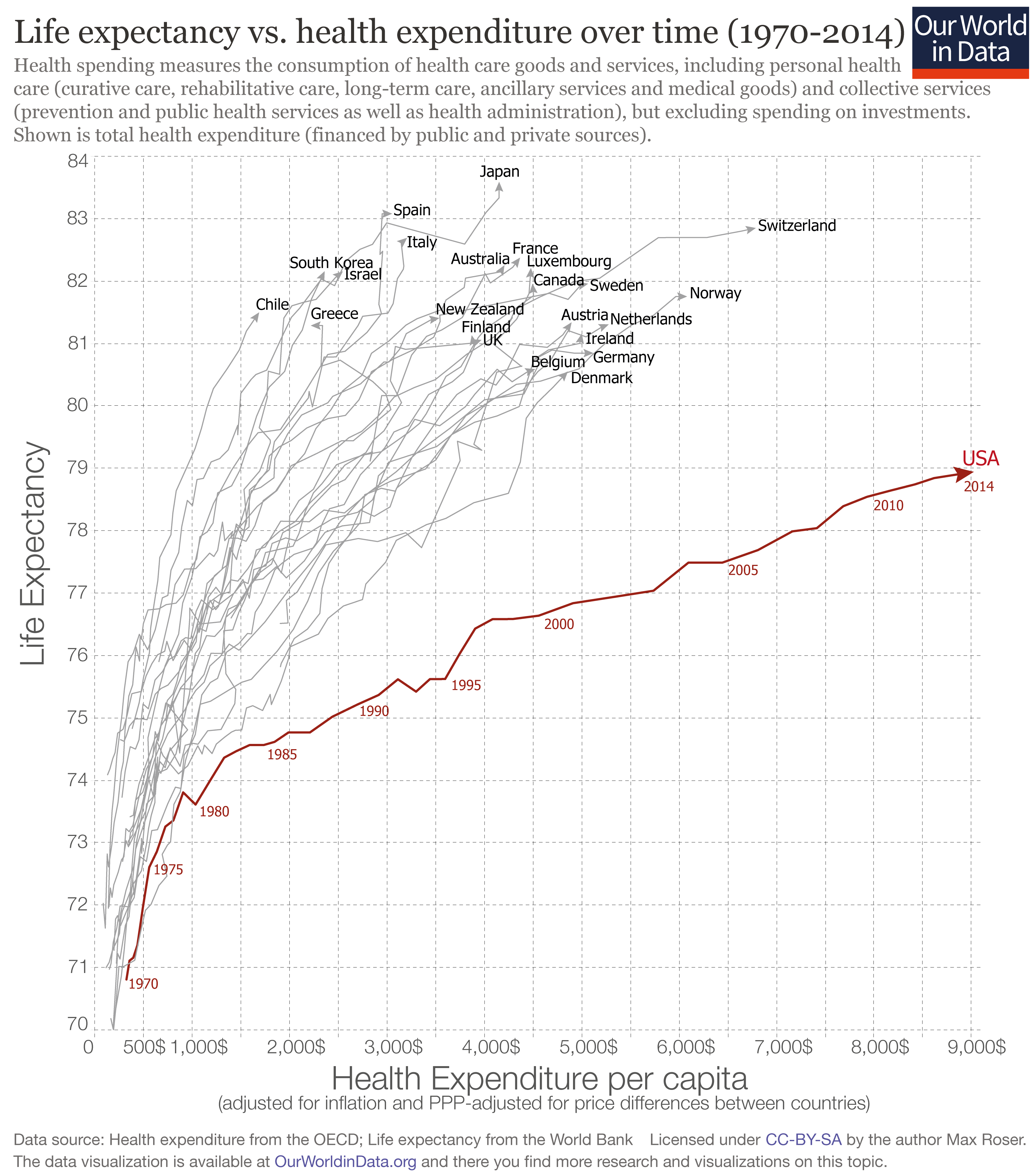
I suppose that anyone who is paying attention to US health care issues knows the basic pattern: the US spends much more on health care on a per capita basis, but life expectancy and other health outcomes in the US are often less than in comparable countries. But here's a striking figure created by Max Roser in July 2016 making this point, and available as one of many useful figures at "Financing Healthcare," by Esteban Ortiz-Ospina and Max Roser, at their "Our World in Data" website.
The figure shows patterns of health spending and life expectancy in various high-income countries from 1970 to 2014. Around 1970, all the countries are down in the bottom left corner of the figure. Over time, both health spending and life expectancy rise everywhere. But as you can see, the US is an outlier. Over the last 45 years or so, US health spending rises to much higher levels than in other countries, while the gains in life expectancy have been much more modest.

The US political arguments over health care have pretty much ignored this pattern: that is, we argue back and forth over costs and coverage of US health insurance, but we spend relatively little time thinking about what public policy steps would most improve health.
The March/April 2017 issue of the Rand Review has a short essay by Doug Irving, "What Are the Social Determinants of Health?" (pp. 6-10), which describes some research in this area. One can make a plausible case that the US could improve its life expectancy and health levels with a tradeoff of less social spending on health care, but more social spending on housing, food, education, drug rehabilitation, and safe neighborhoods. Irving writes:
For a previous post arguing that a substantial share of health spending is wasted, both in the US and around the world, see "Wasteful Health Care Spending" (February 23, 2017).
Homage: I ran across this figure at Mark Thoma's ever-useful "Economist's View" blog.
The figure shows patterns of health spending and life expectancy in various high-income countries from 1970 to 2014. Around 1970, all the countries are down in the bottom left corner of the figure. Over time, both health spending and life expectancy rise everywhere. But as you can see, the US is an outlier. Over the last 45 years or so, US health spending rises to much higher levels than in other countries, while the gains in life expectancy have been much more modest.

The US political arguments over health care have pretty much ignored this pattern: that is, we argue back and forth over costs and coverage of US health insurance, but we spend relatively little time thinking about what public policy steps would most improve health.
The March/April 2017 issue of the Rand Review has a short essay by Doug Irving, "What Are the Social Determinants of Health?" (pp. 6-10), which describes some research in this area. One can make a plausible case that the US could improve its life expectancy and health levels with a tradeoff of less social spending on health care, but more social spending on housing, food, education, drug rehabilitation, and safe neighborhoods. Irving writes:
"Where people live, what kinds of educational opportunities they have access to—these all seem to have strong effects on health,” said Kathryn Pitkin Derose, a senior policy researcher at RAND. ... She uses a simile that has become common in public-health circles to explain that need for a broader view of health care. The current system, she says, is like a lifeguard standing on the banks of a rushing river, always jumping in to rescue people at the last moment as they struggle in the water. What is needed, she says, is a new perspective—a new focus on what causes so many people to fall into the river in the first place, and on addressing those problems before more people follow. “You have to go upstream,” she says, “to see what's really affecting people's health.”It's a question of opportunity cost: when the government devotes so much of its spending and so much of its support for those with low incomes to health care spending, other possibilities for social spending are inevitably constricted.
For a previous post arguing that a substantial share of health spending is wasted, both in the US and around the world, see "Wasteful Health Care Spending" (February 23, 2017).
Homage: I ran across this figure at Mark Thoma's ever-useful "Economist's View" blog.
Tuesday, March 14, 2017
Pigouvian Taxes and Bounties
The idea of a Pigouvian tax traces back to the classic 1920 book by Arthur C. Pigou, The Economics of Welfare. The concept is straightforward. There are certain situations, like those involving pollution, where the unregulated producer of a good does not need to take the social costs of pollution into account. As a result, the private costs of production are not equal to the social costs. In such a situation, one can make a case for the government to impose a tax--a "Pigouvian tax"--which forces the producer to pay for the social costs that it is imposing.
In Part II, Chapter IX of the 1920 book, Pigou discusses "Divergences Between Marginal Social Net Product and Marginal Private Net Product." He offers a clear statement of what modern economists mean by a Pigovian tax, but in the course of explaining the economic logic also provides some ammunition to those who fear that government may have quite a difficult time in applying such taxes. I quote here from the version of Pigou's book available at the always-useful Library of Economics and Liberty website.
Pigou starts the chapter by discussing situations in which social and private costs might not be aligned for reasons of lack of competition, like monopoly, or in situations like landlords and tenant-farmers where it may be difficult to negotiate who will pay for investing in improvements to productive capacity and who will get the benefits. He then moves to the arguments over what modern economists refer to as externalities and public goods. Pigou writes:
"Here the essence of the matter is that one person A, in the course of rendering some service, for which payment is made, to a second person B, incidentally also renders services or disservices to other persons (not producers of like services), of such a sort that payment cannot be exacted from the benefited parties or compensation enforced on behalf of the injured parties. ...
"Among these examples we may set out first a number of instances in which marginal private net product falls short of marginal social net product, because incidental services are performed to third parties from whom it is technically difficult to exact payment. Thus, as Sidgwick observes, "it may easily happen that the benefits of a well-placed light-house must be largely enjoyed by ships on which no toll could be conveniently levied."Again, uncompensated services are rendered when resources are invested in private parks in cities; for these, even though the public is not admitted to them, improve the air of the neighbourhood. The same thing is true—though here allowance should be made for a detriment elsewhere—of resources invested in roads and tramways that increase the value of the adjoining land—except, indeed, where a special betterment rate, corresponding to the improvements they enjoy, is levied on the owners of this land. It is true, in like manner, of resources devoted to afforestation, since the beneficial effect on climate often extends beyond the borders of the estates owned by the person responsible for the forest. It is true also of resources invested in lamps erected at the doors of private houses, for these necessarily throw light also on the streets. It is true of resources devoted to the prevention of smoke from factory chimneys: for this smoke in large towns inflicts a heavy uncharged loss on the community, in injury to buildings and vegetables, expenses for washing clothes and cleaning rooms, expenses for the provision of extra artificial light, and in many other ways.Lastly and most important of all, it is true of resources devoted alike to the fundamental problems of scientific research, out of which, in unexpected ways, discoveries of high practical utility often grow, and also to the perfecting of inventions and improvements in industrial processes. These latter are often of such a nature that they can neither be patented nor kept secret, and, therefore, the whole of the extra reward, which they at first bring to their inventor, is very quickly transferred from him to the general public in the form of reduced prices. The patent laws aim, in effect, at bringing marginal private net product and marginal social net product more closely together. By offering the prospect of reward for certain types of invention they do not, indeed, appreciably stimulate inventive activity, which is, for the most part, spontaneous, but they do direct it into channels of general usefulness."There's a lot of content packed into that paragraph. Pigou is pointing out that private and social costs are likely to be misaligned in various public goods (lighthouses, parks in cities, forests), as well as in the effects of pollution, and in the effects of scientific innovation. In these cases, economic theory suggests the possibility that by using taxes related to the social costs of certain actions (like pollution) or subsidies (he calls them "bounties" related to the social benefits of certain actions, like innovation. Pigou writes:
"It is, however, possible for the State, if it so chooses, to remove the divergence [between social and private costs] in any field by "extraordinary encouragements" or "extraordinary restraints" upon investments in that field. The most obvious forms which these encouragements and restraints may assume are, of course, those of bounties and taxes. Broad illustrations of the policy of intervention in both its negative and positive aspects are easily provided. ...
"The private net product of any unit of investment is unduly large relatively to the social net product in the businesses of producing and distributing alcoholic drinks. Consequently, in nearly all countries, special taxes are placed upon these businesses. Marshall was in favour of treating in the same way resources devoted to the erection of buildings in crowded areas. He suggested, to a witness before the Royal Commission on Labour, "that every person putting up a house in a district that has got as closely populated as is good should be compelled to contribute towards providing free playgrounds."The principle is susceptible of general application. It is employed, though in a very incomplete and partial manner, in the British levy of a petrol duty and a motor-car licence tax upon the users of motor cars, the proceeds of which are devoted to the service of the roads. It is employed again in an ingenious way in the National Insurance Act. When the sickness rate in any district is exceptionally high, provision is made for throwing the consequent abnormal expenses upon employers, local authorities or water companies, if the high rate can be shown to be due to neglect or carelessness on the part of any of these bodies."
In short, Pigou back in 1920 was offering an economic justification for taxes on alcohol and gasoline, as well as for property taxes used to support local parks and amenities. This all holds together as a matter of theory and logic. But as usual when moving from theory to policy, the devil is in the details. Here, I'll point to two sets of concerns that arise from reading Pigou.
First, it's important to remember the decisions about which Pigovian taxes and bounties will be set up that the decisions are not made by the disinterested angels of our better nature, or even by economists, but rather by politicians. Later in the book, Part II, Chapter XX, is titled "Intervention by Public Authorities," and there Pigou offers this important distinction between the theoretical case for Pigouvian taxes and the practical reality:
In any industry, where there is reason to believe that the free play of self-interest will cause an amount of resources to be invested different from the amount that is required in the best interest of the national dividend, there is a prima facie case for public intervention. The case, however, cannot become more than a prima facie one, until we have considered the qualifications, which governmental agencies may be expected to possess for intervening advantageously. It is not sufficient to contrast the imperfect adjustments of unfettered private enterprise with the best adjustment that economists in their studies can imagine. For we cannot expect that any public authority will attain, or will even whole-heartedly seek, that ideal. Such authorities are liable alike to ignorance, to sectional pressure and to personal corruption by private interest. A loud-voiced part of their constituents, if organised for votes, may easily outweigh the whole. This objection to public intervention in industry applies both to intervention through control of private companies and to intervention through direct public operation. On the one side, companies, particularly when there is continuing regulation, may employ corruption, not only in the getting of their franchise, but also in the execution of it. ... On the other side, when public authorities themselves work enterprises, the possibilities of corruption are changed only in form. ... [Here Pigou quotes the US-based Report to the National Civic Federation on Municipal and Private Operation of Public Utilities.] "Every public official is a potential opportunity for some form of self-interest arrayed against the common interest."A second concern is about the potential breadth of the Pigovian argument. Many modern economists would accept the theory of a Pigouvian tax applied in the case of pollution or a Pigouvian bounty applied to subsidizing scientific research, with some degree of hesitancy over the political economy concerns. But Pigou mentions a number of other cases in which social and private costs may diverge. For example:
When construction of factories imposes costs on neighborhoods
"... when the owner of a site in a residential quarter of a city builds a factory there and so destroys a great part of the amenities of the neighbouring sites; or, in a less degree, when he uses his site in such a way as to spoil the lighting of the houses opposite: or when he invests resources in erecting buildings in a crowded centre, which, by contracting the air space and the playing-room of the neighbourhood, tend to injure the health and efficiency of the families living there."
When women work in factories
"Perhaps, however, the crowning illustration of this order of excess of private over social net product is afforded by the work done by women in factories, particularly during the periods immediately preceding and succeeding confinement; for there can be no doubt that this work often carries with it, besides the earnings of the women themselves, grave injury to the health of their children. ... [P]rohibition of such work should be accompanied by relief to those families whom the prohibition renders necessitous."When those who buy new products make other people envious
"For, in some measure, people's affection for the best quality of anything is due simply to the fact that it is the best quality; and, when a new best, superior to the old best, is created, that element of value in the old best is destroyed. Thus, if an improved form of motor car is invented, an enthusiast who desires above all "the very latest thing" will, for the future, derive scarcely any satisfaction from a car, the possession of which, before this new invention, afforded him intense pleasure. In these circumstances the marginal social net product of resources invested in producing the improved type is somewhat smaller than the marginal private net product."When certain industries like agriculture help to make people suitable for military training
"The private net product of any unit of investment is unduly small in industries, such as agriculture, which are supposed to yield the indirect service of developing citizens suitable for military training. Partly for this reason agriculture in Germany was accorded the indirect bounty of protection."When a city plan makes it necessary to demolish some buildings
"Thus it is coming to be recognised as an axiom of government that, in every town, power must be held by some authority to limit the quantity of building permitted to a given area, to restrict the height to which houses may be carried,—for the erection of barrack dwellings may cause great overcrowding of area even though there is no overcrowding of rooms,—and generally to control the building activities of individuals. It is as idle to expect a well-planned town to result from the independent activities of isolated speculators as it would be to expect a satisfactory picture to result if each separate square inch were painted by an independent artist. No "invisible hand" can be relied on to produce a good arrangement of the whole from a combination of separate treatments of the parts. It is, therefore, necessary that an authority of wider reach should intervene and should tackle the collective problems of beauty, of air and of light, as those other collective problems of gas and water have been tackled. ... Furthermore, it may, if desired, be extended to include land on which buildings have already been put up, and may provide "for the demolition or alteration of any buildings thereon, so far as may be necessary for carrying the scheme into effect.""When advertising just cancels out the effect of other advertising
"[I]t may happen that the expenditures on advertisement made by competing monopolists will simply neutralise one another, and leave theindustrial position exactly as it would have been if neither had expended anything. For, clearly, if each of two rivals makes equal efforts to attract thefavour of the public away from the other, the total result is the same as it would have been if neither had made any effort at all."As these examples (and Pigou offers others) suggest, the idea of Pigouvian taxes and bounties applies in any and every situation where someone can make an argument that someone else is affected by a market transaction--even if just makes someone feel bad when someone else buys a new product. It seems to me that almost every public policy argument can be framed in terms of avoiding social costs or gaining social benefits. Again, remember that these arguments are not being made among pure-hearted truth-seekers, but rather in a political setting.
Thus, a question arises of how one disciplines the process of deciding when the Pigouvian logic applies. For example, it's common on one side to hear arguments that there is a case for Pigouvian bounties to subsidize the research and development that leads to new innovations and higher productivity. On the other side, it's common to hear arguments that there is a Pigouvian case for limiting robots or other new innovations so that they don't impose costs on existing workers. But a set of policies that simultaneously encourage and discourage innovation runs a real risk of expressing our ambivalent feelings about new technology in way that is close to incoherent.
A related problem in thinking about Pigovian taxes arises when choosing the tax rate. For example, in the case of alcohol there is some evidence that moderate consumption may have health benefits, through a reduction in blood pressure. However, inappropriate and excessive consumption of alcohol can also lead to drunken driving, violence, fetal alcohol syndrome, and other consequences. Thus, it seems as if the appropriate Pigouvian tax on alcohol should be to subsidize the light social drinker, but to impose a high tax on drinkers who impose high social costs. When the effects of an action on third parties are heterogenous in this way. choosing an appropriate Pigouvian tax becomes tricky, and society may well feel a need for use of alternative or complementary policy tools.
Like many economists, I favor certain taxes and subsidies on Pigouvian grounds. But it's worth remembering that the arguments in such cases are not just technocratic, but ultimately involve value judgments about political economy and social welfare.
Subscribe to:
Posts (Atom)