Monday, July 6, 2020

An Audit Study of Discrimination in the Boston Rental Market

Audit studies are one of the most persuasive ways to show real-world discrimination. The idea is to come up with pairs of potential applicants or buyers, where each pair is given background information that makes them essentially identical--except for a difference in race. Then these pairs of people enter into the economy by taking actions like renting an apartment, applying for a job or a loan, or buying a car.  In some audit studies, like applying for certain job, an audit study can be done without actual people, just by constructing resumes and social media links, and seeing who gets a response at all and who gets invited for an actual interview. In these studies, the difference in race just involves using names or differences in interests that can act as a signal of race to the person (or the software?) looking at the job applications. In other audit studies, actual pairs of people are matched up.  


One additional factor in the rental markets is whether prospective renters say that they are planning to use a voucher for subsidized housing, or whether they were just planning to pay the full market rate. Thus, this study   involved 200 "testers," who were divided into groups of four who were given similar characteristics and background: "Specifically, the test coordinator created matched pairs who were demographically similar (i.e., cisgender, same sex, no visible disabilities, age) and assigned the testers similar characteristics like income, family size, and credit score." The 50 potential rentals were randomly selected from public lists. The testers were also told to communicate with housing providers within the same fairly short time window, and to make the original communication in the same way (for example, by phone call or text). Within each group of four testers,  two were black and two were white, and two said they were planning to pay full market rate while the other two were planning to use a housing voucher.

With this background: 
The study measured a number of data points including:
  • whether testers were able to make appointments to see the properties;
  • how many units housing providers told testers about or showed them;
  • whether housing providers offered financial incentives;
  • whether housing providers made positive or negative comments about the housing units; and
  • whether housing providers offered testers an application. 
Here's a summary of some results: 
Results indicate that White market-rate testers— meaning White testers not using vouchers—were able to arrange to view apartments 80% of the time. Similarly situated Black market-rate testers seeking to view the same apartments were only able to visit the property 48% of the time. Testers who had vouchers, regardless of their race, were prevented from viewing apartments at very high rates. White voucher holders were able to view rental apartments only 12% of the time. Black voucher holders were able to view apartments they were interested in renting only 18% of the time. ... In addition, housing providers showed White market-rate testers twice as many apartment units as Black market-rate testers, and provided them with better service as measured by a number of different variables. The results also showed that testers who were offered a site visit by the housing provider received differential treatment at the visit based on race and voucher status. 
Of course, no social science methodology is truly bulletproof. One might wonder, for example, if the sample size is large enough, or the matched pairs of rental applicants were really the same, or if the problem of discrimination is especially severe in Boston rental markets. Because any single study can be questioned into exhaustion, one looks for other studies--and it turns out that these findings are broadly similar to the results of previous audit studies of  housing markets done at other places and times. 

For example, Newsday did its own audit study last fall looking at real estate agents. ""Newsday conducted 86 matching tests in areas stretching from the New York City line to the Hamptons and from Long Island Sound to the South Shore. Thirty-nine of the tests paired black and white testers, 31 matched Hispanic and white testers and 16 linked Asian and white testers." The testers interacted with 93 real estate agents in the Long Island area, and found pervasive evidence of racial bias. For a number of other studies, I've in the past discussed "Audit Studies and Housing Discrimination" (September 21, 2016). 

There's an old saying in social science that data is not the plural of anecdote: that is, you can pile up a lot of anecdotes, but it's inevitably hard to know if such stories tell what happened, or what people think might have happened, or whether they reveal a common or a rare event. The growing body of audit studies in US housing markets is not a bunch of anecdotes: it's data showing that racial discrimination which is illegal under existing law is in fact disturbingly pervasive in US housing markets. I would love to see a wave of these audit studies of housing market discrimination carried out around the country, with loud publicity for the results and also with some legal consequences attached. It would be socially useful if rental agents and real estate agents needed to take seriously the possibility that the ways in which they are treating their minority customers could come under public scrutiny.
 

Saturday, July 4, 2020

Can Economists Be Both Popular and Patriotic?

Alfred Marshall argued that students of social science are bound to dwell on the "limitations and defects and errors" of whatever is popular and whatever will sell more newspapers. Conversely, any economist  who receives popular approval should assume that they have failed in their intellectual mission. The sentiment is actually attributed from A.C. Pigou to Marshall. It reads:
Students of social science, must fear popular approval: Evil is with them when all men speak well of them. If there is any set of opinions by the advocacy of which a newspaper can increase its sales, then the student who wishes to leave the world in general and his country in particular better than it would have been if he had not been born, is bound to dwell on the limitations and defects and errors, if any, in that set of opinions: and never to advocate them unconditionally even in ad hoc discussion. It is almost impossible for a student to be a true patriot and to have the reputation of being one in his own time.
The source of the quotation is "In Memoriam: Alfred Marshall," a speech given by A.C. Pigou in 1924 and published as part of a Memorials of Alfred Marshall volume in 1925 (pp. 81-90). The  quotation attributed to Marshall appears on p. 89.

A number of interesting questions lurk here. Does an economist have a duty, to self and to society, to play the role that Marshall describes in public discourse? What about in ad hoc discussion? Is that duty appropriately called "patriotism"? It does seem to me that if you find yourself in a specific setting where you know more, there is some ethical or moral duty not to use your knowledge to take undue advantage of others. This applies to all professions--car mechanics and sommeliers, as well as financial advisers and economists. But it also seems to me that people wear different hats at different times, and a commitment to live all aspects of one's life enunciating "the limitations and defects and errors" of popular opinions seems to exalt an attitude of grumpy oppositional monasticism, which may not be a utility-maximizing way for economists (or anyone else) to live.

"My Country, Right or Wrong": No Patriot Would Say It

In the 21st century, I'm not sure how many Americans would ever actually say "my country, right or wrong." After all, it's not "countries" that are right or wrong, but actions of governments and people, and it seems ingrained in the American character (and thankfully so!) that criticizing one's government is not only acceptable, but often expected.

But perhaps the ultimate put-down for that point of view came from G.K. Chesterton, In a 1901 collection of essays, The Defendant, he includes an essay called "A Defense of Patriotism." Chesterton writes:
'My country, right or wrong,' is a thing that no patriot would think of saying except in a desperate case. It is like saying, 'My mother, drunk or sober.' No doubt if a decent man's mother took to drink he would share her troubles to the last; but to talk as if he would be in a state of gay indifference as to whether his mother took to drink or not is certainly not the language of men who know the great mystery.
If faced with a situation where the government of a country has done something terribly wrong, and considering whether to betray the country as a result, even a patriot might defend an ultimate loyalty to the nation by saying "My country, right or wrong." But it's a sentiment that would only come up when the "wrong" was deeply and profoundly wrong, and the immediate options were grim. It's a statement that would arise only from a spirit torn with near-despair and great humility, and would not be made in a spirit of pride, or even defiance.

A Refresher on Humans, Angels, and Government

One can loosely divide American preferences about the role of government into two groups: those who think that because people and markets are not angels, more government actions are needed, and those who think that because people and government are not angels either, fewer government actions are needed. A classic statement behind this dilemma comes from James Madison in the Federalist Papers #51. In discussing the design of the US government, he wrote:
"Ambition must be made to counteract ambition. The interest of the man must be connected with the constitutional rights of the place. It may be a reflection on human nature, that such devices should be necessary to control the abuses of government. But what is government itself, but the greatest of all reflections on human nature? If men were angels, no government would be necessary. If angels were to govern men, neither external nor internal controls on government would be necessary. In framing a government which is to be administered by men over men, the great difficulty lies in this: you must first enable the government to control the governed; and in the next place oblige it to control itself. A dependence on the people is, no doubt, the primary control on the government; but experience has taught mankind the necessity of auxiliary precautions."
In arguing for the government to control itself, Madison laid out a system with a separation of powers with two different legislative houses; an executive branch headed by a separately elected president; and an appointed-but-subject-to-confirmation judicial branch. The idea wasn't new to Madison, of course. Arguments for the separation of legislative and executive are made in John Locke's (1690) Second Treatise on Government, although Locke tended to view the power of judging, via magistrates, as an offshoot of legislative power. Montesquieu is often credited with the the first explicit division of governing powers into legislative, executive and judiciary in his 1748 book The Spirit of the Laws. For example, Montesquieu writes (in translation) in Book XI, Chapter 6:
When the legislative and executive powers are united in the same person, or in the same body of magistrates, there can be no liberty; because apprehensions may arise, lest the same monarch or senate should enact tyrannical laws, to execute them in a tyrannical manner. Again, there is no liberty if the judiciary power be not separated from the legislative and executive. Were it joined with the legislative, the life and liberty of the subject would be exposed to arbitrary control; for the judge would be then the legislator. Were it joined to the executive power, the judge might behave with violence and oppression.
Economics is not willing to assume that angels are taking human form--not among business executives, workers, consumers, taxpayers, voters, nor among who are elected, appointed, or hired to government posts. It can feel frustrating when society and government seems to struggle against itself and may even become unable to act, with conflicts between branches and their differentiated responsibilities. But the alternative of a government in which acts without such constraints is, at least to me, a considerably less attractive prospect.

Friday, July 3, 2020

US Immigration: Attitudes and Workplace

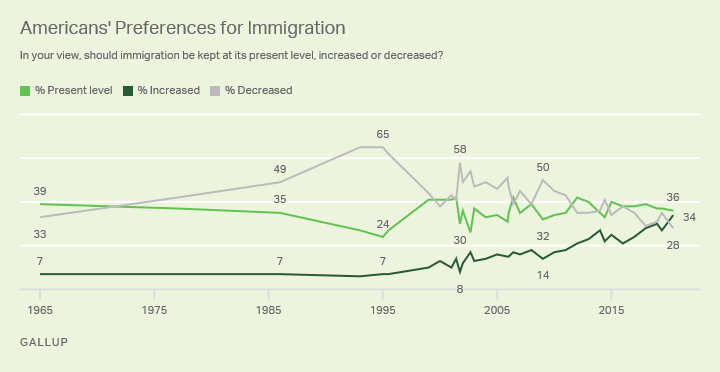
Each year in June, the Gallup organization does a national poll on attitudes toward immigration. Here's the answer to a basic question: should immigration be kept at its present level, increased, or decreased? 
As you can see, from the 1960s up through the mid-1990s, the share who wanted to increase immigration was quite low at about 7%. In 1995, 65% wanted to decrease immigration. 
Immigration1
But opinions on immigration have shifted dramatically in the last 25 years and perhaps especially since around 2010. The "present level" group has often been roughly one-third of the total over time, with some fluctuations. But the share wanting "increase" has been rising over the last 25 years,and in the early June survey it came in higher than the share wanting "decrease." 

One reason for the shift, I suspect, is that the foreign-born share of the US workforce has been rising during this period. Moreover, the foreign-born workers as a group have become more likely to have college degrees.  One additional factor is that the rise number of immigrants without legal status flattened out back in the 2007-2009 recession, and the number of people in this category hasn't been rising since then. A recent Congressional Budget Office report provides a data-based look at "The Employment of Foreign-Born People" (June 2020) wrote:   
The foreign-born population of the United States was 46 million in 2018, representing 1 out of every 7 people. Twenty years earlier, in 1998, 1 out of every 10 people had been born abroad. Over the past two decades, the foreign-born population increased by 61 percent, outpacing the 13 percent increase in the native-born population. A key component of that growth was the increase in the number of foreign-born people with legal status; by CBO’s estimate, that number grew from 20 million, or 72 percent of foreign-born people, in 1998 to 35 million, or 76 percent of foreign-born people, in 2018. At least 90 percent of foreign-born people with legal status were naturalized citizens or lawful permanent residents, according to data from the Department of Homeland Security; the rest had temporary legal status usually associated with study or work. The numbers of foreign-born people both with and without legal status grew between 1998 and 2007, according to CBO’s estimates, but most of the growth thereafter was among people with legal status.
Moreover, the CBO report shows an ongoing shift toward higher education levels for the foreign-born in the last couple of decades. 
This shift has been widely noted. As one example, a National Science Foundation report pointed out earlier this year
Foreign-born workers—ranging from long-term U.S. residents with strong roots in the United States to more recent immigrants—account for 30% of workers in S&E occupations. The number and proportion of the S&E workforce that are foreign born has grown. In many of the broad S&E occupational categories, the higher the degree level, the greater the proportion of the workforce who are foreign born. More than one-half of doctorate holders in engineering and in computer science and mathematics occupations are foreign born.
I'm sure that part of the shift toward encouraging more immigration is less about the issue itself, and is just politics: in this case, a pushback against President Trump's anti-immigration rhetoric. For example, Democrats rather abruptly began to increase their support of free trade after Trump took office threatening protectionism early in 2017. But these underlying shifts in attitudes toward immigration, along with shifts in numbers and skill levels, didn't just start in the last few years: they have been evolving over time. 

Thursday, July 2, 2020

Religion and Life Outcomes: Looking for Causal Effects

The pervasiveness of US religious belief has seemed to decline in the last 30 years or so, by a variety of measures. Daniel Hungerman investigates "Religious Institutions and Economic Wellbeing" in the most recent issue of Future of Children (Spring 2020, pp. 9-28). As a starting point, here's a figures from Hungerman showing the fall in US religious belief over time (using data from the General Social Survey). 
The decline in religiosity seems likely to continue, because the shift is especially large among younger age groups. 
Or here's a figure showing that the share of charitable giving going to religious organizations was about half back in the 1980s, but it now down to about 30%. 

Why this shift started happening around 1990s isn't altogether clear. The sex scandals afflicting the Catholic Church, for example, are not especially prominent in the broad public eye until the early 2000s. There's some nondefinitive evidence that increasing levels of education may tend to reduce religious belief. There's also a sense that in  many people's minds, religion has become more entangled in politics, which has led some people to react by drawing back from religious belief.  

But Hungerman's main focus is about the effects of this change. It's well-known that religious people often typically report being happier, and are more likely to vote, less likely to use drugs or commit crimes, and so on. But correlation isn't causation. Ideally, one might want to do an experiment where some people randomly become committed to religion while an otherwise identical comparison group does not do so, but this particular experiment seems impractical. Indeed, it seems plausible that those who choose to participate in religion may differ in some underlying way from those who do not. So how can a researcher try to find evidence, one way or another, of causal effects? 

I'll just say up front that there's no perfect way to find a pure causal effect from religion to economic outcomes. Instead, like a lot of social science issues, one instead tries to tackle the question from a variety of angles in specific research studies, and then see what overall pattern starts to emerge. Thus, the array of examples also gives a sense of how the minds of social scientists work. For example, here are some of the examples and approaches discussed by Hungerman:  

Matching people who are equivalent in the non-religious variables we can observe
Dehejia, DeLeire, and Luttmer examine whether religious individuals’ consumption and self-reported wellbeing appear to be relatively less sensitive to income shocks—that is, whether religion helps “insure” people against negative shocks. ... [T]he authors use a variety of methods, such as applying a procedure that matches each religious person in a sample to an observationally similar nonreligious person, so that the final data sample contains a similar distribution of observable characteristics across religious and nonreligious individuals. They find that religiosity does indeed insure against negative shocks.
Looking at whether more of your neighbors share your religious tradition
Gruber proposes a creative strategy: using variation in the ethnic composition of one’s community to study the impact of religion. Put simply, an American of Italian ancestry may not make much of a distinction between living in a neighborhood full of Swedish individuals versus a neighborhood full of Polish individuals—except that the latter group, like Italians, are Catholic. If living side-by-side with ethnicities that share your religious tradition makes you more religious, but otherwise doesn’t affect your wellbeing, than we can use ethnic composition to learn about the causal effects of religion.
Gruber finds, again, that religiosity leads to better outcomes for a number of economic indicators.
Peer groups in schools
Especially noteworthy is a study by the economists Jane Fruehwirth, Sriya Iyer, and Anwen Zhang. In an approach similar to Gruber’s, they exploit variation in the religiosity of peers across cohorts within a school to identify how religion influences mental health in a sample of US adolescents. They find that religion plays an important causal role in promoting mental health.
A lottery for attending the Haj
David Clingingsmith, Asim Khwaja, and Michael Kremer. They look at the effects of attending the Hajj—the pilgrimage to Mecca that Muslims are expected to make at least once during their lifetime. To study how attending the Hajj affects people’s values, Clingingsmith, Khwaja, and Kremer use a Pakistani lottery that allocates Hajj visas; they find that participation in the Hajj leads to greater acceptance of female education and employment. More generally, Hajj lottery winners show both increased Islamic observance and greater belief in equality and harmony among all religions.
Distance from Wittenberg
The great social scientist Max Weber famously considered whether a Protestant ethic for work might drive the difference between economic wellbeing in Protestant and Catholic communities. Becker and Woessmann take up this association in several steps. First, they put it to a careful test in historic Prussia, exploiting the fact that Protestantism expanded from its birthplace in Wittenberg (a previously unimportant town) in a pattern akin to concentric circles. Moving away from Wittenberg, you encounter all sorts of terrain and all types of communities—but places farther from Wittenberg are less likely to be Protestant, all else equal. Becker and Woessmann then confirm that distance from Wittenberg appears unrelated to various controls (such as the presence of schools in the 1500s, before the reformation), but centuries later it does predict income and economic circumstance—being closer to Wittenberg (and therefore more Protestant) is better for economic wellbeing. This suggests that the link between GDP and Protestant affiliation is more than a simple association. Does this mean Weber was right? Not quite. The final step of Becker and Woessmann’s study shows that variation in literacy can largely explain the economic gains of Protestantism. It appears that the Protestant emphasis that everyone should be able to read the Bible (and thus be able to read), rather than a “noncognitive” work ethic, can explain why Protestant societies had higher economic productivity.
Interaction of religion with laws about alcohol and gambling
Looking at the United States, Jonathan Gruber and I investigated this by looking at the repeal of “blue laws” that restrict economic activity on a certain day of the week (often Sunday).40 Most recent blue laws are narrow in focus—for example, alcohol can’t be sold at grocery stores before noon on Sundays. But not that long ago, many states had strong blue laws that prohibited most Sunday economic activity. A Supreme Court ruling in 1961 provided a test by which these laws could be repealed, and many were consequently undone. Gruber and I show that when such laws are undone, religiosity declines, and that risky behavior such as heavy drinking increases— but the increases are driven by those who report having been religious before the repeal occurred.  ... Religious rules appear to be effective in discouraging heavy drinking and gambling. The results [from another study] often indicate that the most religious individuals are those who are likeliest to substitute: it’s the most religious groups whose religious giving declines when casinos open or when commerce is allowed on Sundays, and it’s the most religious individuals who are likely to start drinking heavily when the legal drinking age changes.
Figuring out causal connections from religion to life and economic outcomes is a challenging research project. But the weight of the evidence Hungerman discusses--only a bit of which I've mentioned here--is that those who end up being exposed to religion do seem to experience measurable benefits, which in a broad sense take the form of bolstering a person's confidence and determination in following a path of learning, saving, and work--and avoiding being derailed by overindulgence in counterproductive habits. 

I'll also append here the full Table of Contents for this issue of Future of Children. It seems to have an even higher-than-usual proportion of interesting essays, and I may post some additional commentary about other essays in the next week or so. 

Wednesday, July 1, 2020

The Productivity That Didn't Happen

The bad news is that US productivity growth has been slow for the last 15 years, and in facts for 30 of the last 40 years. But at least other high-income nations are doing worse. Emily Moss, Ryan Nunn, and Jay Shambaugh provide a nice readable overview of productivity fact patterns, along with possible causes and solutions, in "The Slowdown in Productivity Growth and Policies That Can Restore It" (June 2020, Hamilton Project at Brookings). 

It's conventional to divide US productivity growth since 1948 into four periods, summarized in this figure. There's the reasonably rapid post-World War II productivity growth from 1948 to 1973, the slowdown from 1973-1995, a 10-year resurgence from 1995-2004, and the return-to-slowdown since then. 
The US situation doesn't look good, but in fact, we're going better than other high-income countries. The fact that the productivity slowdown encompasses all the high-income countries has an important implication: it suggests that at least some of the most important causes are not specific to US economic policy or indeed to the policies of any one country, but instead must be causes that would apply broadly across all high-income countries. 

Don't forget that the numbers on the figures above are annual rates. For example, US labor productivity drops from an annual rate of 3.1% from 1995-2004 to an annual rate of 1.4% from 2004-2018. This annual change accumulates over time.  To get a feeling for the importance of this accumulation,  let's say that labor productivity had continued to rise by 3% per year since 2004. The extra growth could have led to gradually higher incomes every year. As a result of labor productivity growing 1.6% per year faster over the last 16 years, the total US economy in 2020 would be 29% larger. 

Given that US GDP will be about $22 billion this year, 29% works out to $6.4 trillion larger. For perspective, $6.4 trillion works out to roughly an extra $20,000 in 2020 for every US citizen, including adults and children. This is not a one-time boost, but a permanent and ongoing rise. For people, for government, for social problems, for the environment--every problem is a little easier to solve when the financial constraints are relaxed. But because productivity growth slowed down in 2004, those resources never came into existence. 

The reasons for these rises and falls in productivity are largely mysterious to economists. The problem is not a lack of hypotheses, but rather a sense that when you offer lots of possible explanations, perhaps you aren't all that sure about any of them. For example, if the more recent productivity slowdown had kicked in after the Great Recession, one could come up with a hypothesis related to the Great Recession--but it clearly started well before that. 

One possible explanation is that this is mostly a mismeasurement problem. The argument here is that GDP doesn't capture the economic gains of new technology, so the productivity gains don't show up in official statistics. There's no doubt that the official statistics are imperfect, but but the question here is whether they somehow became more imperfect circa 2004; that is, they captured the rise in productivity growth and the web pretty well for a decade, but then stopped doing so. There isn't much evidence to support that belief. Moreover, the decline in US productivity after the 1995-2004 burst has been quite broad across industries. To put it another way, it doesn't seem as if productivity is only down in certain harder-to-measure industries. 

In addition, while it would certainly be nice to believe that our standard of living is rising in all sorts of ways not measured by actual dollars, our household bills and mortgage debt and taxes and government borrowing need to be paid with actual money, not just with a nebulous feeling of being better off. 

While the struggle to explain the timing and breadth of the changes in productivity goes on, some of the intellectual energy has instead shifted toward thinking about what might help reverse the pattern, regardless of its underlying cause. I sometimes like to say that there's the basic formula for productivity is well-understood: it's a combination of human capital, physical capital, and new technology, interacting in an economic environment with incentives for innovation. Here are a few thoughts from Moss, Nunn, and Shambaugh on these issues, with more in the actual report: 

On the issue of human capital, America's rise in average education level has slowed down, and the aging population means slower growth in the prime-age labor force. They write: 

For cohorts born from 1876 to 1951, average educational attainment rapidly increased by 0.8 years per decade, with successive generations receiving about two additional years of education relative to their predecessors. The pace of this increase has now slowed: cohorts born from 1951 to 1987 have added only about 0.3 years per decade ...
Slower growth in the prime-age labor force tends to coincide with slower growth in productivity, perhaps because of a reduction in available managerial talent (Feyrer 2007, 2011) or the rate of business formation (Karahan, Pugsley, and Åžahin 2019). The aging of the workforce can also place downward pressure on productivity growth by making it more difficult to implement new innovations and processes ...
When it comes to private investment, firms don't seem to be doing a lot more of it. Here's a figure showing investment by firms in the specific area of information processing equipment and software. It's probably not a coincidence that the sharp rise starting in about 1990 was followed by rising productivity a few years later, and conversely that the drop in 2000 was also followed by lower productivity a few years later. 
One my my hobby-horses on this blog is the need to increase research and development spending. As the figure shows, total R&D as a share of GDP hasn't risen for decades. But what is changing is that the federal share of R&D which tends to focus on basic research and thus on potential breakthrough innovations is falling, while the business share of R&D which is more likely to focus on near-term development of products is rising. 

When it comes to increasing productivity, there are a number of other areas that deserve attention, many of which involve trying to strike a better balance: Can we figure out ways to provide inventors with a return that also encourage follow-up inventions by others? Can we figure out ways to encourage competition and limit anticompetitive behavior? Could adjusting rules related to occupational licensing or residential building help labor to become more productive? Could investments in infrastructure for transportation, energy, and communications help labor and industries be more productive?

The only way for the average person in a nation to consume more in the long-run is for that average worker to have higher productivity in the long-run. Yes, for a time it's possible to raise taxes on the rich and transfer to others. It's possible for the government and firms and people to borrow money for a time and raise consumption in the present, too. Redistribution and borrowing are useful for specific circumstances, and for certain times and places, but by themselves, they can't continually raise consumption for the average person. Only rising productivity can do that.